How to Choose a Web Design Agency in Dubai: A Buyer's Checklist



Choose a web design agency in Dubai by running eight checks before you sign: your own brief, a valid UAE licence, live sites that work on a phone, accessibility, search and AI readiness, a specific written proposal, every account in your name from day one, and reviews the agency does not control. Agree the support terms after launch in writing too.

Most businesses in Dubai pick a web design agency the same way: a few portfolio links, a call or two, and the quote that feels right. The trouble shows up later, when the site is slow on a phone, a change costs more than expected, or the domain turns out to be registered to someone else.
None of those problems are hard to spot in advance. They just need the right questions, asked before the contract is signed rather than after launch. This guide turns those questions into eight checks you can run on any shortlist, whatever the size of your project.
Each figure below is linked to its original source, and none of it is a sales pitch for a particular agency. Use it to compare us, or anyone else.
In this guide
Before you contact any agency, write one page on what the website has to do, who it is for, and what it must connect to. A clear brief is the only way to get quotes you can compare, because every agency then prices the same job instead of its own guess at it.
Your brief does not need to be technical. It needs answers to these questions:
If you are still deciding between a ready-made theme and a site designed from scratch, read our comparison of a template or custom build first. It changes which agencies belong on your shortlist.
Ask every agency for its trade licence and check it yourself on an official portal. A real business will share its licence number without hesitation, and the licensed activity should cover the work you are buying. Two minutes of checking here removes the biggest risk on the list.
The UAE government portal lists the official places to verify a business licence, a business name and its activities, including the Dubai Economy and Tourism licence search and the National Economic Registry. Agencies registered in a free zone are checked with that free zone's authority instead.
Two more checks take a minute each:
Ask for links to live websites, not screenshots, and open them on your phone first. Most visits in the UAE come from mobile devices, so a design that only looks good on a large screen is not doing its job. Then test the speed of two or three of those sites with Google's free tool.
In September 2026, mobile accounted for 60.04% of web visits in the UAE, against 38.91% for desktop, according to StatCounter. And almost everyone is online: DataReportal put UAE internet use at 99.0% of the population in January 2025.
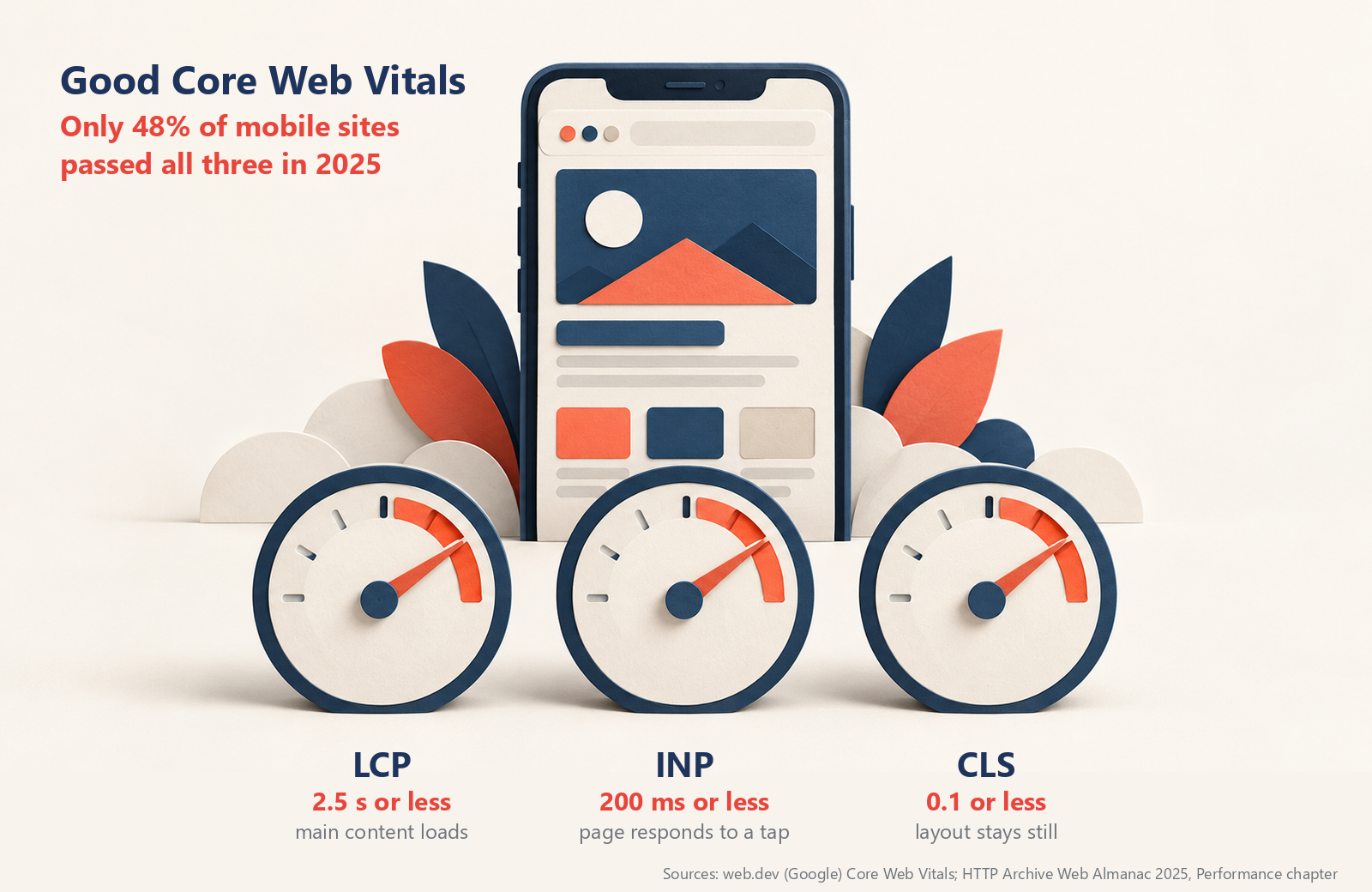
Speed is where many sites fall short. Google's Core Web Vitals set three "good" thresholds: the main content should load within 2.5 seconds (LCP), the page should respond to a tap within 200 milliseconds (INP), and the layout should not jump around (CLS of 0.1 or less). Only 48% of mobile websites met all three in 2025, according to the HTTP Archive Web Almanac.
First impressions matter for your own visitors too. Research by the Nielsen Norman Group found the first 10 seconds of a visit are critical to whether people stay or leave (a 2011 study, still widely used). If you would like an outside view of your current site before you brief anyone, a UX audit gives you that baseline.
Ask which accessibility standard the agency builds to, and expect a specific answer: WCAG 2.2 at level AA. It is a testable standard published by the W3C, so it belongs in the contract. Clear contrast, readable text and labelled forms also help every visitor on a small screen.
The W3C's WCAG 2.2 has three levels, A, AA and AAA, and adds nine new success criteria, such as minimum sizes for buttons and links you tap. The basics are still widely missed: only around 31% of mobile sites meet the minimum colour contrast requirement, and around 13-14% of images have no alt attribute at all, according to the Web Almanac accessibility chapter.
Good questions to ask: how do you test colour contrast and keyboard use, who writes the image descriptions, and are form fields labelled so screen readers can read them?
Ask to see live bilingual sites the agency has built and switch between the two languages. The Arabic version should mirror properly from right to left, including menus, forms and tables, rather than simply swapping the text. Also ask who will write and update the Arabic content. Our guide to building an Arabic and English website covers what to check in detail.
Ask the agency what it sets up so search engines and AI assistants can find, read and trust your site, and who owns those settings afterwards. A good answer covers clean page structure, page titles and descriptions, a sitemap, and Google Analytics and Search Console set up in your own accounts. A vague "SEO is included" is not an answer.
More people now ask ChatGPT, Gemini or Google's AI answers for recommendations before they search the usual way. Those tools tend to quote pages that answer a question clearly, show who is behind them and are easy to read for both people and machines. You do not need an agency to promise you rankings or AI mentions; nobody can promise either. You do need one that builds a site those tools can read.
Ask these four questions:
One simple test: ask an AI assistant about the agency itself, or search for it, and see what comes back. Our guide on how to get cited by AI chatbots explains what those tools look for. Moving from an older site? Our guide to refresh or rebuild covers how to keep existing search traffic.
A good proposal says exactly what you get, what it costs, how changes are handled and who owns the work at the end. If two quotes look far apart, the cause is usually in the scope, so compare them line by line rather than on the total. Anything spoken but not written down does not count.
Check that each proposal covers:
Data protection is not optional. The UAE government's data protection page explains that the federal law prohibits processing personal data without the owner's consent, with limited exceptions. Contact forms, newsletter sign-ups and analytics all collect personal data, so ask how consent, the privacy notice and data storage will be handled.
For what the money covers and how to compare three quotes side by side, see our breakdown of what a website costs in Dubai.
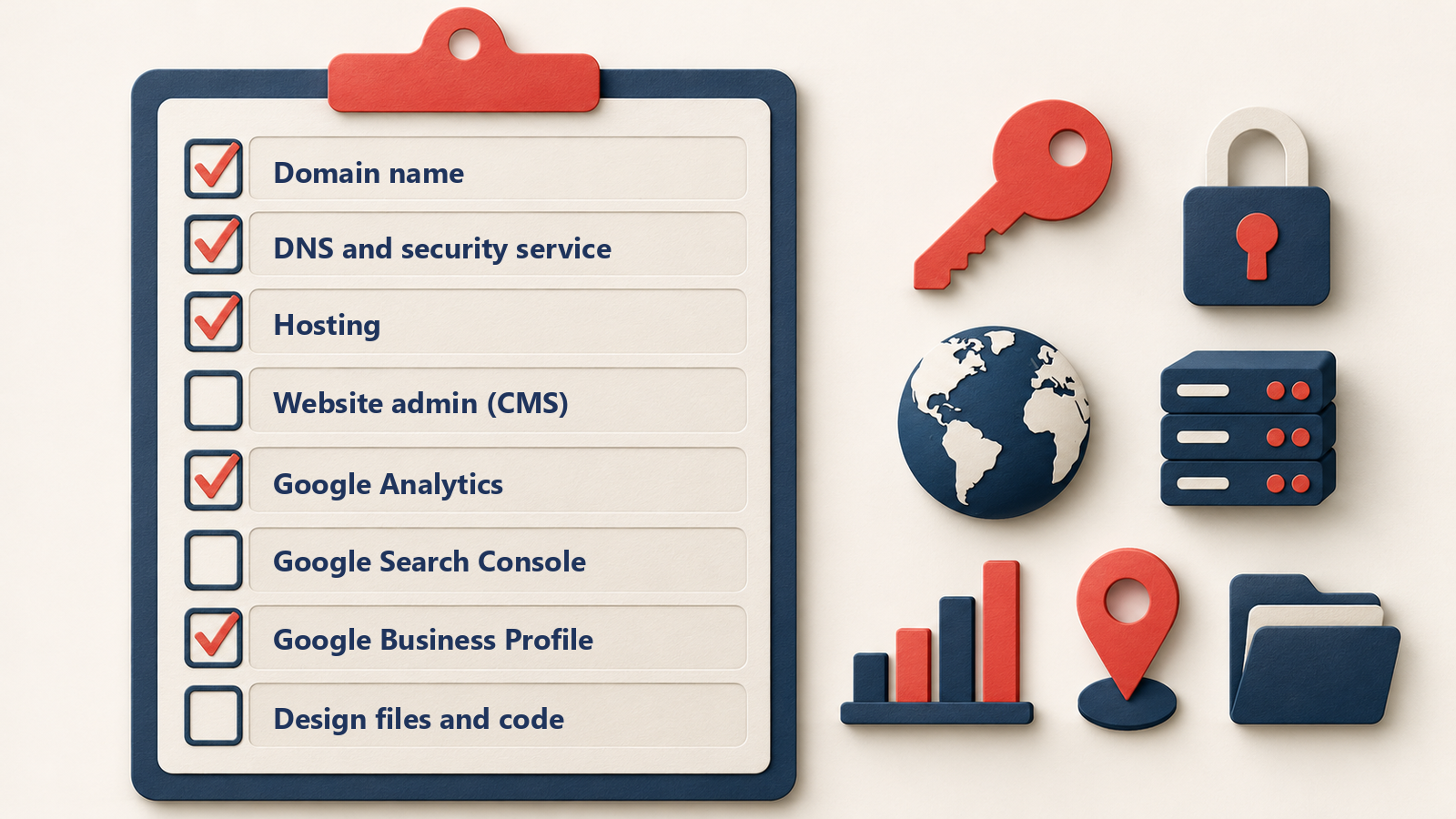
Every account your website depends on should be registered to your business, with your email address as the owner, from the start of the project. The agency can be given access to do its work. When an account is opened under the agency's details instead, moving to a new team later becomes slow and sometimes expensive.
This matters most for the domain. Under the .ae Domain Name Policy, the registrant does not own a domain name but holds an exclusive licence to use it, and the TDRA notes that only your registrar may change your domain details, and only with your permission. So the registrant should be your company, not the agency.
| Account | Why it matters | What to check |
|---|---|---|
| Domain name | Your address on the web and your email | Registered in your company name, with your contact email |
| DNS and security service | Controls where the domain points | Your login, agency added as a user |
| Hosting | Where the site lives | Billed to your business, your login |
| Website admin (CMS) | Editing pages and content | An owner-level account for you, separate from the agency's |
| Google Analytics | Your visitor and enquiry data | You are the property administrator |
| Google Search Console | How Google sees and indexes your site | You are a verified owner |
| Google Business Profile | Your listing on Google Maps | You are the primary owner |
| Design files and code | Needed to change or move the site later | Delivered to you at handover, or kept in a repository you own |
Look for reviews the agency does not control, and speak to at least one past client. Testimonials on an agency's own site are chosen by the agency. Independent reviews and a short reference call tell you how it handles deadlines, problems and changes of plan.
Agree in writing what support you get after the site goes live: how long bugs are fixed without charge, what counts as a bug versus a new request, and what ongoing maintenance costs. Websites need updates, backups and security fixes, so plan for them before launch rather than after the first problem.
If you would rather have one team look after updates, backups and security, see our website maintenance service.
Score each agency from 1 to 5 on the eight checks below after your calls, then compare the totals. The scorecard keeps the decision about the same questions for every agency, so the most confident pitch does not win by default. Weight the rows that matter most to your project.
| Check | What a good answer looks like | Red flag | Agency A | Agency B | Agency C |
|---|---|---|---|---|---|
| Licence and VAT | Licence number shared, verified on an official portal; VAT shown separately | Will not share a licence; no VAT line | |||
| Live portfolio | Live links that work well on a phone and pass Core Web Vitals | Screenshots only; slow or broken sites | |||
| Accessibility | Names WCAG 2.2 AA and explains how it is tested | "Our designs are accessible" with no standard | |||
| Search and AI readiness | Explains page structure, sitemap and analytics in your accounts | "SEO included" with no detail, or ranking promises | |||
| Proposal and contract | Written scope, revisions, milestones, ownership clause | Vague scope; full payment upfront | |||
| Account ownership | Every account in your name from day one | Domain or hosting in the agency's name | |||
| Reviews and references | Independent reviews and a past client you can call | Only testimonials on its own site | |||
| After launch | Written support terms and a handover process | No answer on what happens after go-live |
These are the questions to put to every agency on your shortlist, in the same order, so you can compare the answers. Ask them in writing as well as on a call, and keep the replies with the proposal.
Walk away, or at least slow down, if you see any of these. Each one is cheap to spot before signing and expensive to fix after launch.
The right agency is the one that answers these questions clearly, in writing, before you pay anything. Shortlist three, send each the same brief, score them on the same eight checks, and keep every account in your name.
If you would like Crafixx on your shortlist, send your brief to our web design agency in Dubai and put these questions to us as well. Projects that need integrations are scoped with our web development company in Dubai team, and online stores with our e-commerce development team, with a written quote before work starts.
Ask Us Anything!
No agency is best for every project; what matters is the best fit for yours. Many "top agency" lists online are written by agencies that include themselves. Use the eight checks and the scorecard in this guide to compare your shortlist on the same questions, and give the most weight to live work, written terms and independent reviews.
It depends on the type of site, who builds it and what it has to connect to, so quotes vary widely. Compare quotes on scope rather than the total, and check whether VAT is included. Our website cost guide, linked in the proposal section above, sets out published market ranges with sources.
Three is usually enough to compare approaches and prices without the process taking over. Send all three the same brief and ask the same questions, so the answers are comparable.
It should at least build the foundations: clean page structure, titles and descriptions, a sitemap, fast mobile pages, and analytics in your own accounts. Ongoing SEO work can be separate, but a site built without those basics costs more to fix later.
You should. The domain belongs under your trade name with your contact email, and you keep owner-level access to hosting, the website admin, Google Analytics and Search Console. The contract should hand the design files and code over to you when the last payment clears.
Not necessarily, but a licensed UAE business is easier to verify, can issue UAE tax invoices if it is VAT-registered, works in your time zone and understands local requirements such as data protection and bilingual content. Whoever you choose, run the same checks.
We use cookies to help you navigate efficiently and perform certain functions. You will find detailed information about all cookies under each consent category below.
The cookies that are categorised as "Necessary" are stored on your browser as they are essential for enabling the basic functionalities of the site.
We also use third-party cookies that help us analyse how you use this website, store your preferences, and provide the content and advertisements that are relevant to you. These cookies will only be stored in your browser with your prior consent.
You can choose to enable or disable some or all of these cookies but disabling some of them may affect your browsing experience.