Template vs Custom Website: What Dubai Businesses Really Pay for Cheap Design



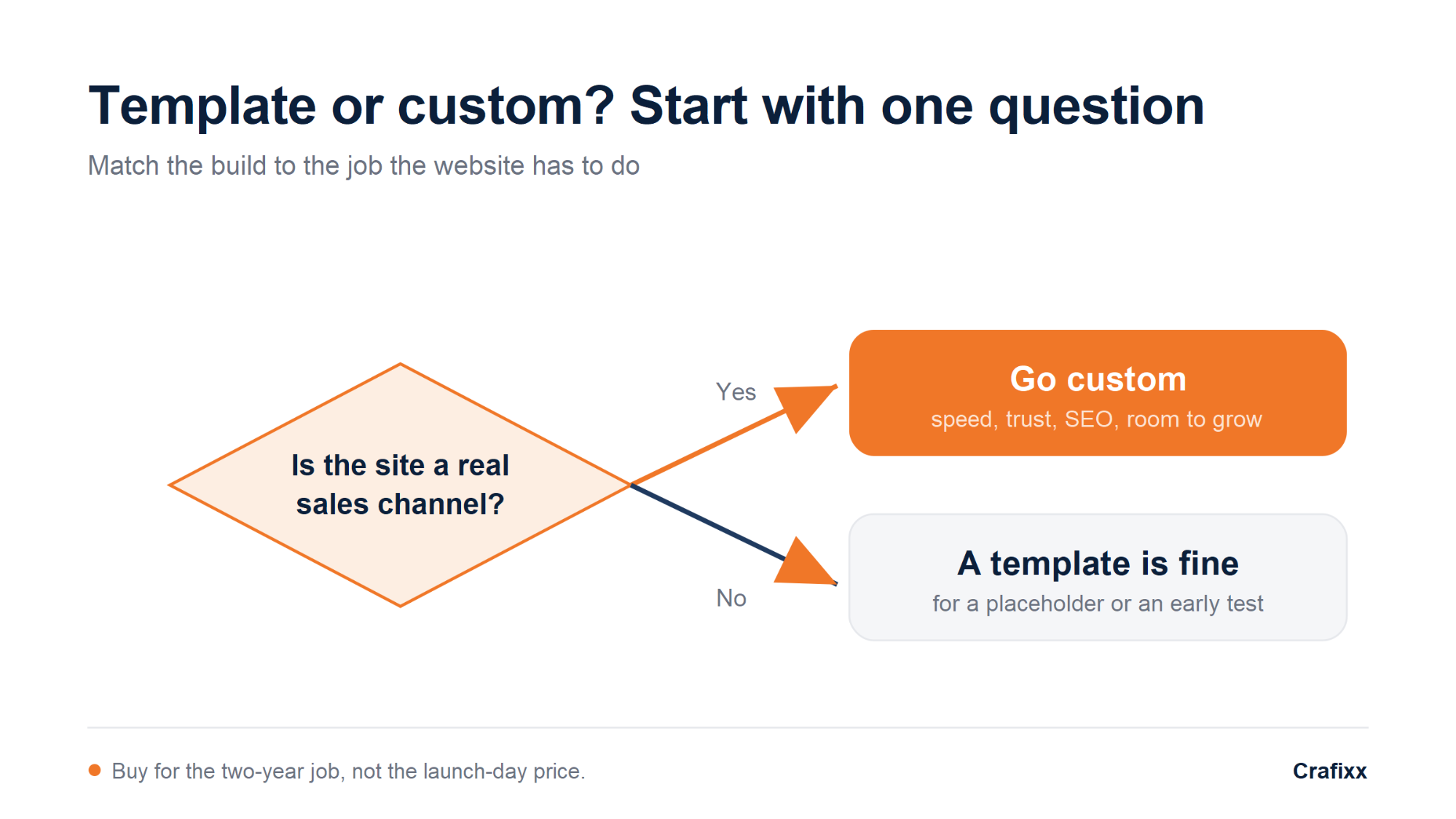
A template is fine for a simple or temporary site. For a real sales channel, a custom build is usually the cheaper choice once you count speed, trust, SEO and the rebuild you avoid. Cheap design is rarely cheap in the long run. The price you see at the start is not the price you pay over two years of lost speed, lost trust and lost leads. This guide breaks down the real trade-off, honestly, so you can choose the right option for your stage and budget.
Direct answer: A template is a pre-built design you pour your content into. A custom website is designed and built around your specific business, customers and goals.
With a template, you adapt your business to the design. With a custom build, the design adapts to your business. That single difference drives almost every other trade-off below: speed, uniqueness, SEO, scalability and total cost.
Direct answer: Templates win on speed and upfront cost. Custom wins on performance, uniqueness, SEO and room to grow. Here is the honest trade-off for each, template first, then custom.
| Pros | Cons |
| Lower upfront cost Fast to launch No coding needed Fine for a simple or temporary site |
Generic and easy to forget |
| Pros | Cons |
| Unique to your brand | Higher upfront cost |
| Leaner and faster Built for SEO and AI search Scales with the business Fully yours, with tailored features and integrations |
Longer to build Needs a capable team or agency |
Direct answer: Templates are cheap to buy but expensive to live with, because their real costs show up after launch, not before.
The upfront saving is real, but so is the compounding cost. The question is not which is cheaper today, it is which is cheaper across the life of the site.
Direct answer: Template sites usually lean on many third-party plugins to do what they need, and plugins are where most website security holes live.
In 2025, 91 percent of new WordPress vulnerabilities were found in plugins rather than the core software, out of 11,334 logged across the ecosystem, up 42 percent on the year before (Patchstack, State of WordPress Security in 2026). Every extra plugin a template needs to stretch beyond its original design is another door to lock. A leaner, purpose-built site simply has fewer doors.
Direct answer: Templates tend to hurt you most on speed, first impressions and search visibility, the three things that decide whether a visitor stays and buys.
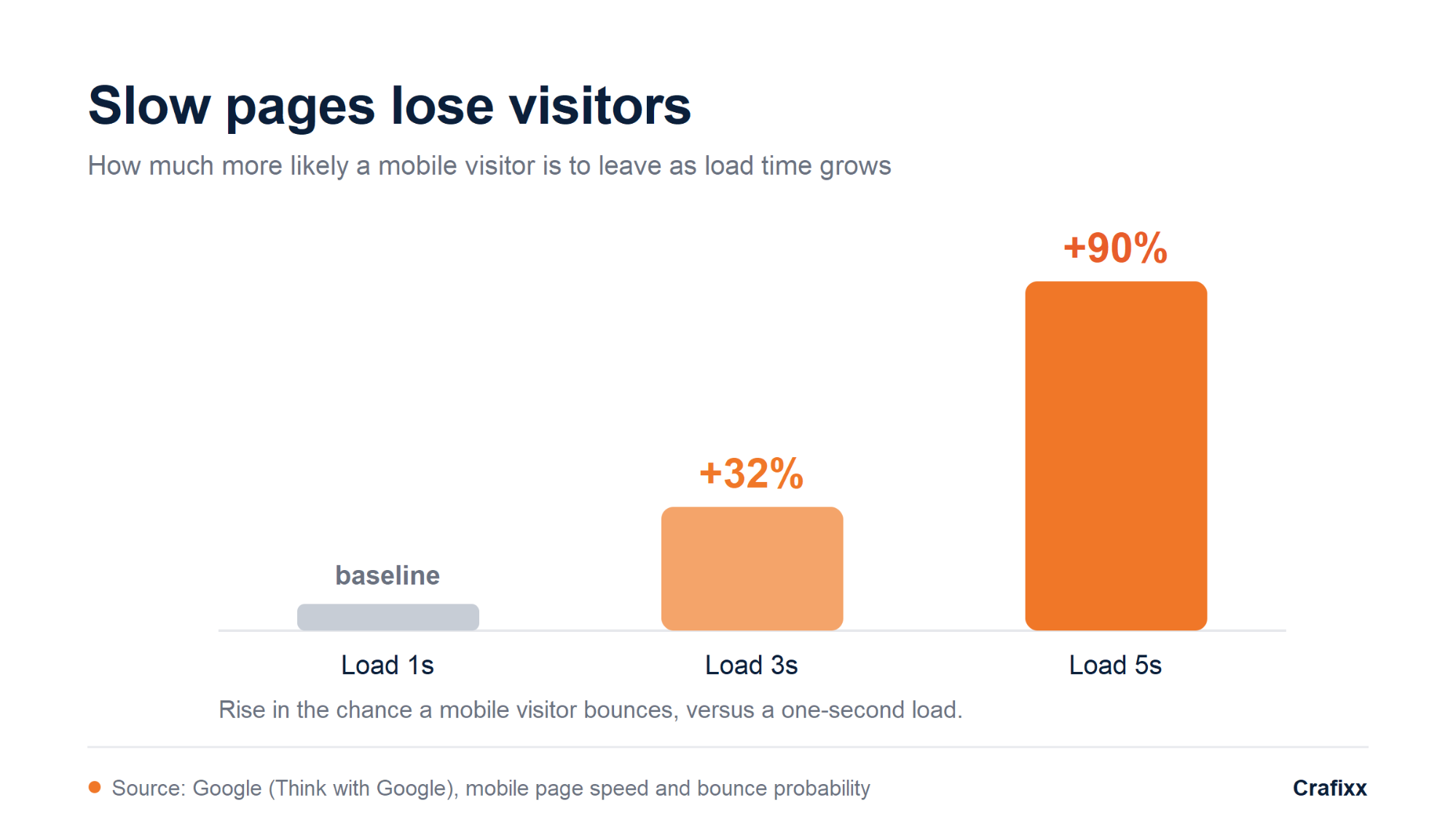
Speed. Heavier template code loads slower, and speed moves money. Google found that as page load time rises from one second to three, the chance a mobile visitor leaves goes up 32 percent, and by five seconds it climbs to 90 percent (Google). In a joint Google and Deloitte study, improving load time by just 0.1 second lifted retail conversions by 8.4 percent (Google and Deloitte, Milliseconds Make Millions).
First impressions. Users form a first impression of a website in about 50 milliseconds, mostly from visual design (Nielsen Norman Group). A template that looks like everyone else spends that moment making you forgettable, at the exact point a stranger is deciding whether to trust you.
Search and AI visibility. Rigid template structures make it harder to add clean headings, fast pages and the answer-style content that both Google and AI engines reward.
Direct answer: A template is the smart choice when the website is simple, temporary or a low-stakes test, and speed to launch matters more than differentiation.
There is no shame in starting with a template. The mistake is staying on one after your business has outgrown it.
Direct answer: You need custom when your website is a core sales channel, when you have specific workflows, or when trust and differentiation directly affect revenue.
This is where strong web design, solid web development and thoughtful UI and UX stop being a cost and start being an investment that returns leads.
| Dimension | Template | Custom |
| Upfront cost | Lower | Higher |
| Time to launch | Fast | Longer |
| Speed and performance | Often heavier | Built lean |
| Uniqueness and trust | Generic | Distinctly yours |
| SEO and AI readiness | Limited by structure | Built in |
| Scalability | Hits a ceiling | Grows with you |
| Long-term cost | Rework likely | Lasts longer |
| Best for | Simple or temporary sites | Growth and lead generation |
Direct answer: A custom website is not just a nicer design, it is a faster, more findable, more scalable foundation that you fully own.
For stores, this is also why a purpose-built ecommerce build usually outperforms a stretched template once orders and catalogue grow.
Direct answer: In Dubai, a generic template is a bigger liability than elsewhere, because the market is crowded, mobile-first and often bilingual.
Pair that with SEO from the start, and a custom site compounds in value while a template plateaus.
Direct answer: Match the build to the job the site has to do, not to the cheapest sticker price.
Ask Us Anything!
Often yes, if the website drives leads or sales. Custom gives you speed, differentiation and SEO strength that a template cannot match. If the site is only a simple placeholder, a template is enough for now.
A template is a pre-built design you fit your content into. A custom website is designed and built around your business, so it is faster, more unique and easier to grow.
Not automatically, but many templates carry heavy code and rigid structures that slow pages and limit clean, answer-style content, which holds back both search rankings and AI citations.
Because their costs arrive after launch: slower speed, plugin sprawl, security risk, and the rebuild many businesses pay for once they outgrow the template.
Yes. A template is a reasonable starting point to test an idea. Just plan for the move so you are not rebuilding under pressure once the business grows.
Usually, because a custom build includes only the code you need, while templates carry features you never use. Speed directly affects bounce rate and conversions.
We use cookies to help you navigate efficiently and perform certain functions. You will find detailed information about all cookies under each consent category below.
The cookies that are categorised as "Necessary" are stored on your browser as they are essential for enabling the basic functionalities of the site.
We also use third-party cookies that help us analyse how you use this website, store your preferences, and provide the content and advertisements that are relevant to you. These cookies will only be stored in your browser with your prior consent.
You can choose to enable or disable some or all of these cookies but disabling some of them may affect your browsing experience.