Shopify in the UAE vs WooCommerce vs a Custom Store: Which Fits Your Business?



Shopify works in the UAE, and Shopify Payments now pays out in dirhams to UAE LLCs and Sole Establishments. It suits most retail stores that want hosting, security and updates handled for them, with plans from $24 a month on yearly billing. WooCommerce has no monthly platform fee and gives you full ownership of the code and data, but you pay for hosting and upkeep yourself. A custom build only makes sense when your business model does not fit a standard catalogue, cart and checkout.
Most platform decisions in the UAE start with Shopify. It has a UAE pricing page, and its own payment service now accepts UAE businesses. The question worth asking is not whether Shopify is good. It is whether the way Shopify charges, and what it asks you to give up, fits the store you are actually building.
This guide compares the three routes a UAE retailer realistically has: Shopify, WooCommerce and a custom build. It uses the platforms' own published prices and rules, checked on 22 September 2026, and covers what each one costs, how you get paid in AED, what happens with Arabic, and what the Federal Tax Authority expects from your store before you launch.
Yes. Shopify is available to UAE businesses, and it is widely used: Store Leads counted 26,892 live Shopify stores in the UAE in its report updated on 18 September 2026, up 16% year on year in the second quarter of 2026.
The bigger change is on payments. Shopify's help centre now lists the United Arab Emirates as a Shopify Payments country, which means UAE stores can take credit and debit cards and accelerated checkouts through Shopify's own processor instead of connecting a separate gateway. The eligibility rules are specific:
Payouts arrive in dirhams on every plan, with USD available through Multi-Currency Payouts. Shopify's UAE payouts page sets the minimum settlement time at 5 business days, and payments captured on Friday, Saturday and Sunday are combined into a single payout. Plan your cash flow around that gap.
Shopify's UAE pricing page lists four plans, priced in US dollars. Yearly billing is cheaper than paying month to month. Each plan also sets the card rate you pay through Shopify Payments, and a separate fee if you use a third-party payment provider instead.
| Plan | Per month, billed yearly | Per month, billed monthly | Card rate (Shopify Payments) | Fee if you use a third-party provider |
|---|---|---|---|---|
| Basic | $24 | $32 | 2.9% + AED 1 | 2% |
| Grow | $69 | $92 | 2.8% + AED 1 | 1% |
| Advanced | $299 | $399 | 2.7% + AED 1 | 0.6% |
| Plus | From $2,300 | Not listed | 2.5% + AED 1 | 0.2% |
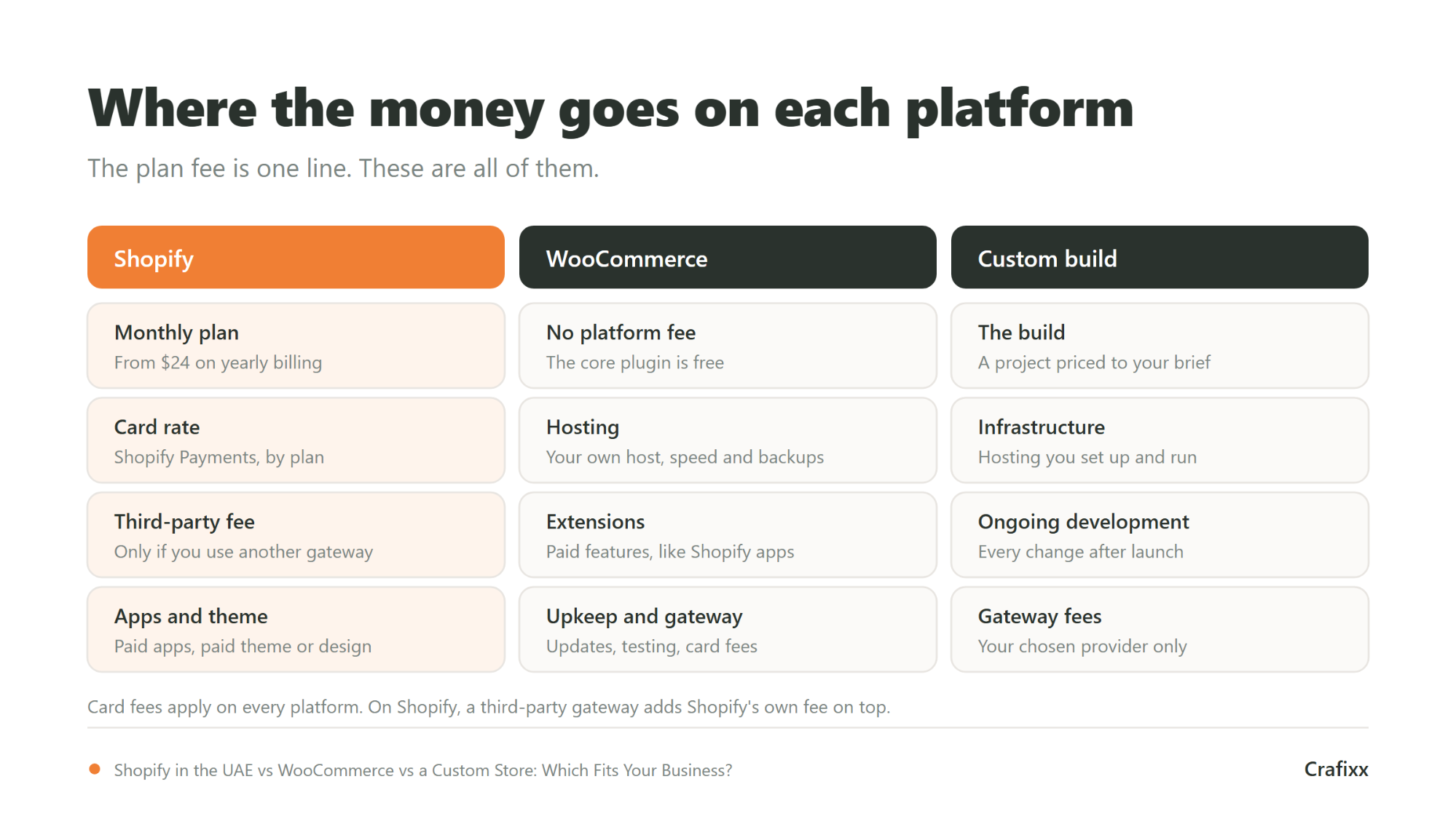
The plan fee is only one line of the bill. Three others decide what Shopify really costs:
WooCommerce is a free, open-source plugin for WordPress. Its own site describes it as having no "monthly platform fees", and you fully own the site, the code and the data. That ownership is its main advantage over Shopify.
Free software does not mean a free store. With WooCommerce, the costs Shopify bundles into its plan fee become separate bills that you arrange yourself:
Hosting. WooCommerce runs on your own web hosting, so speed, uptime and backups depend on the host you choose.
Two widely used options both work for UAE businesses. WooPayments supports the UAE, although UAE businesses cannot use its Individual account type, and its published UAE fee is 2.90% + AED 1 per card payment, plus 2% for international cards and 2% for currency conversion. Stripe's UAE pricing is 2.9% + AED 1 for domestic cards, plus 1% for international cards and another 1% if currency conversion is needed.
A custom store is built from scratch for your business, with no platform deciding what the checkout, the catalogue or the account area can do. That freedom is real, and so is the cost: you pay for the build, then for hosting and for every change after launch, because there is no app store to fall back on.
It is worth it in a narrow set of cases:
If none of those apply, a custom build usually means paying more to reach what Shopify or WooCommerce already do. Our comparison of template and custom websites works through the same trade-off for brochure sites, and most of it applies to stores too.
| Shopify | WooCommerce | Custom build | |
|---|---|---|---|
| Hosting and security | Included and managed by Shopify | Your own host; you manage security and backups | Your own infrastructure; you manage everything |
| Platform fee | Monthly plan, from $24 on yearly billing | None for the core plugin | None, but you pay for the build |
| Payment fees | Shopify Payments card rate, or a gateway fee plus Shopify's third-party fee | Your chosen gateway only | Your chosen gateway only |
| Extra features | Paid apps | Paid extensions | Built to order |
| Updates | Applied by Shopify | You or your developer apply and test them | Your development team |
| Ownership | You own your data; the platform is Shopify's | You own the site, code and data | You own the code and data |
| Arabic, right to left | Depends on the theme supporting RTL | WordPress detects RTL languages; the theme must support RTL | Built in if it is in the brief |
| Best for | Most retail stores that want to launch and sell without running servers | Businesses that want ownership, already use WordPress, or need to customise heavily | Marketplaces, complex B2B and stores tied to other systems |
Decide how you will get paid in dirhams early, because each option has its own eligibility rules and onboarding documents. For the platforms in this guide, the published options are:
| Option | Works with | Published UAE card fee | Notes |
|---|---|---|---|
| Shopify Payments | Shopify | 2.5% to 2.9% + AED 1, by plan | LLCs and Sole Establishments with a CRN and an AE IBAN; AED payouts, minimum 5 business days |
| WooPayments | WooCommerce | 2.90% + AED 1 | +2% international cards, +2% currency conversion; no Individual accounts in the UAE |
| Stripe | WooCommerce and custom builds | 2.9% + AED 1 | +1% international cards, +1% currency conversion |
UAE banks and local payment companies also offer gateways that plug into Shopify, WooCommerce and custom stores. Where a provider does not publish its rates, ask for a written quote that covers the full card rate, the settlement time and the onboarding documents before you choose. If you use one with Shopify, remember that Shopify's third-party fee applies on top.
Yes on both, with one condition that catches people out: Arabic reads right to left, and the theme has to support that. Shopify's language guidance tells merchants translating into right-to-left languages such as Arabic to check that the theme supports them so the layout displays correctly. Arabic is also not on the list of languages Shopify translates professionally, so the translations come from you, a translator or an app.
WordPress, which WooCommerce runs on, detects right-to-left languages and loads right-to-left styling when a theme provides it. The same rule applies: pick a theme built for RTL, or budget for making it work. Our guide to building an Arabic and English website covers the structure and design decisions in more detail.
VAT applies to your store whichever platform you choose, and the platform has to be set up for it from day one. The Federal Tax Authority sets three rules that shape a UAE store:
Shopify, WooCommerce and custom builds can all handle VAT-inclusive pricing, but none of them decide your tax position for you. Set the tax settings to match your registration, and have your accountant check the first invoices before you launch.
| Question | If your answer is... | Lean towards |
|---|---|---|
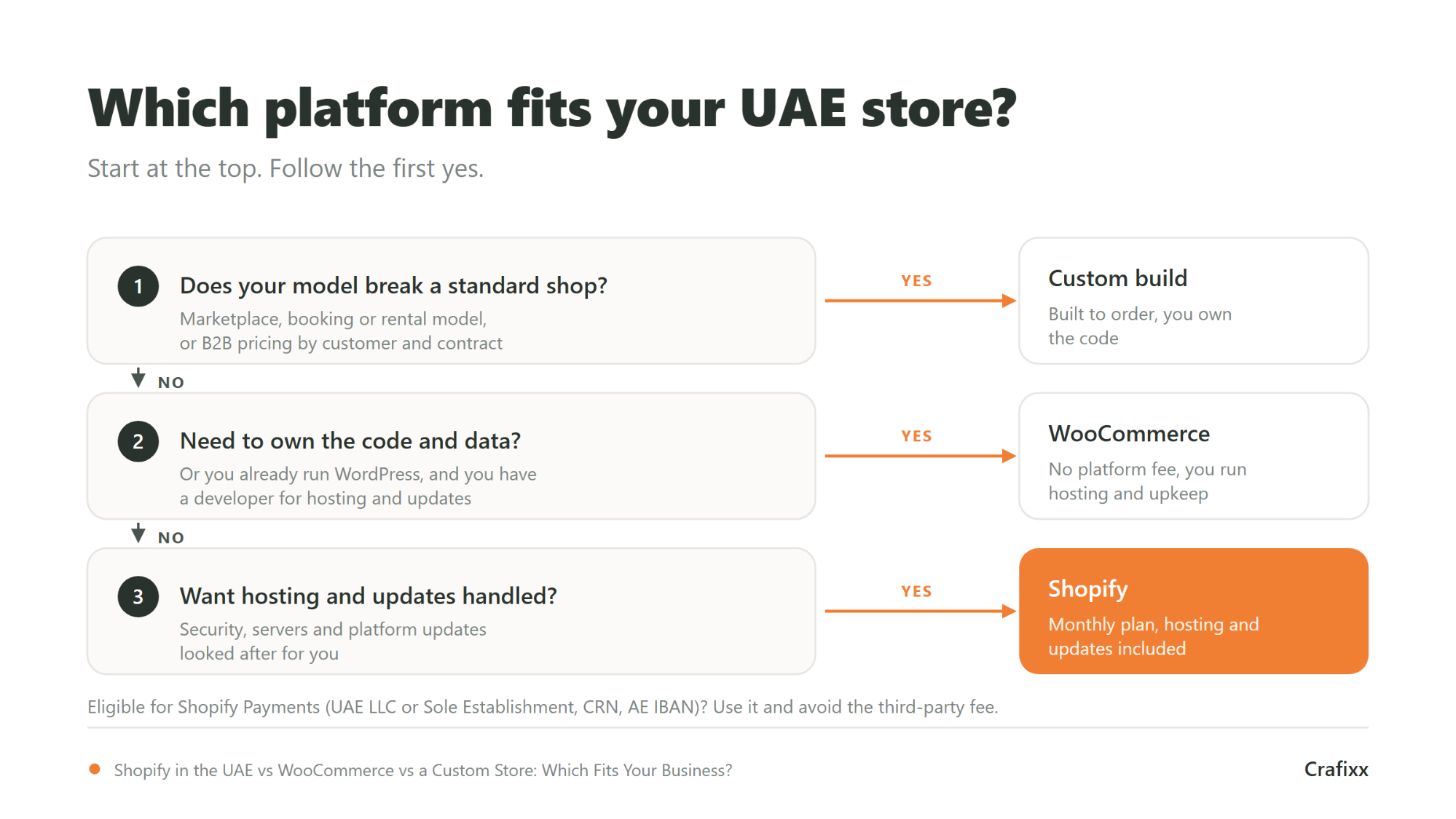
| Does your store follow a standard catalogue, cart and checkout? | No, it is a marketplace, a booking model or complex B2B pricing | Custom build |
| Who will look after hosting, security and updates? | Nobody in-house, and you do not want to hire for it | Shopify |
| Do you need to own the code and data? | Yes, or you already run WordPress | WooCommerce |
| Are you eligible for Shopify Payments? | Yes: an LLC or Sole Establishment with a CRN and an AE IBAN | Shopify, without the third-party fee |
| Does the store have to sync with an ERP or warehouse system? | Yes, in real time | WooCommerce or custom, with API integration planned from the start |
Ask Us Anything!
Crafixx understands your concern. Therefore, security is not just a feature but also a promise. We craft smart, optimized, and meticulously custom-coded solutions that follow the latest frameworks and globally compliant tools. Our methodology rejects outdated scripts/shortcuts as we adhere to international compliance protocols. This is how Crafixx works as a web development company in Dubai to keep your data safe and fortified.
Crafixx understands your concern. Therefore, security is not just a feature but also a promise. We craft smart, optimized, and meticulously custom-coded solutions that follow the latest frameworks and globally compliant tools. Our methodology rejects outdated scripts/shortcuts as we adhere to international compliance protocols. This is how Crafixx works as a web development company in Dubai to keep your data safe and fortified.
Staying tech-aware is not an option but an instinct of a truly innovative web design company in the UAE. The Crafixx team keeps a close eye on emerging trends across code, creativity, and user experience. Be it AI-powered tools, next-gen design software, or modular frameworks, Crafixx always dives deep into it. Our process revolves around evolving algorithms & updates, decoding Meta’s ad shifts, aligning projects with performance-first, and absorbing global influences to match the speed of change.
Our deep grasp of new-age market dynamics, amalgamated with integrity, can carve out a way to build lasting relationships with sophisticated clientele all around the world. We take time to understand your brand + audience, + expectations before crafting custom solutions. Crafixx is more than a Software Development company in Dubai, UAE, because it does not just create but strategically designs with purpose.
We use cookies to help you navigate efficiently and perform certain functions. You will find detailed information about all cookies under each consent category below.
The cookies that are categorised as "Necessary" are stored on your browser as they are essential for enabling the basic functionalities of the site.
We also use third-party cookies that help us analyse how you use this website, store your preferences, and provide the content and advertisements that are relevant to you. These cookies will only be stored in your browser with your prior consent.
You can choose to enable or disable some or all of these cookies but disabling some of them may affect your browsing experience.

for opt the service.
Our represntative will join this meeting on given time.