The Corporate Identity Checklist for New UAE Businesses



Sixteen items, and the order matters more than the list. Clear your trade name with the licensing authority first, because UAE naming rules can reject a name you have already designed around. Then decide what the business stands for. Then design. Then apply it everywhere and give one person the authority to keep it consistent. Most new companies start at the logo and pay to redo the first three steps later.
Key takeaways
Most new companies in the UAE build their identity in exactly the wrong order.
It usually goes like this. Someone has an idea and a name they like. A designer is briefed, a logo comes back, and it goes onto a domain, a business card and an Instagram profile within a fortnight. The work looks fine. Everyone is pleased.
Then the trade name gets submitted for approval and comes back rejected, or the domain turns out to be taken by a company in the same category, or the whole thing has to appear in Arabic on a building and nobody designed for that.
None of these are design problems. They are sequencing problems, and they are expensive precisely because the design was already finished.
Here is the order that avoids them.
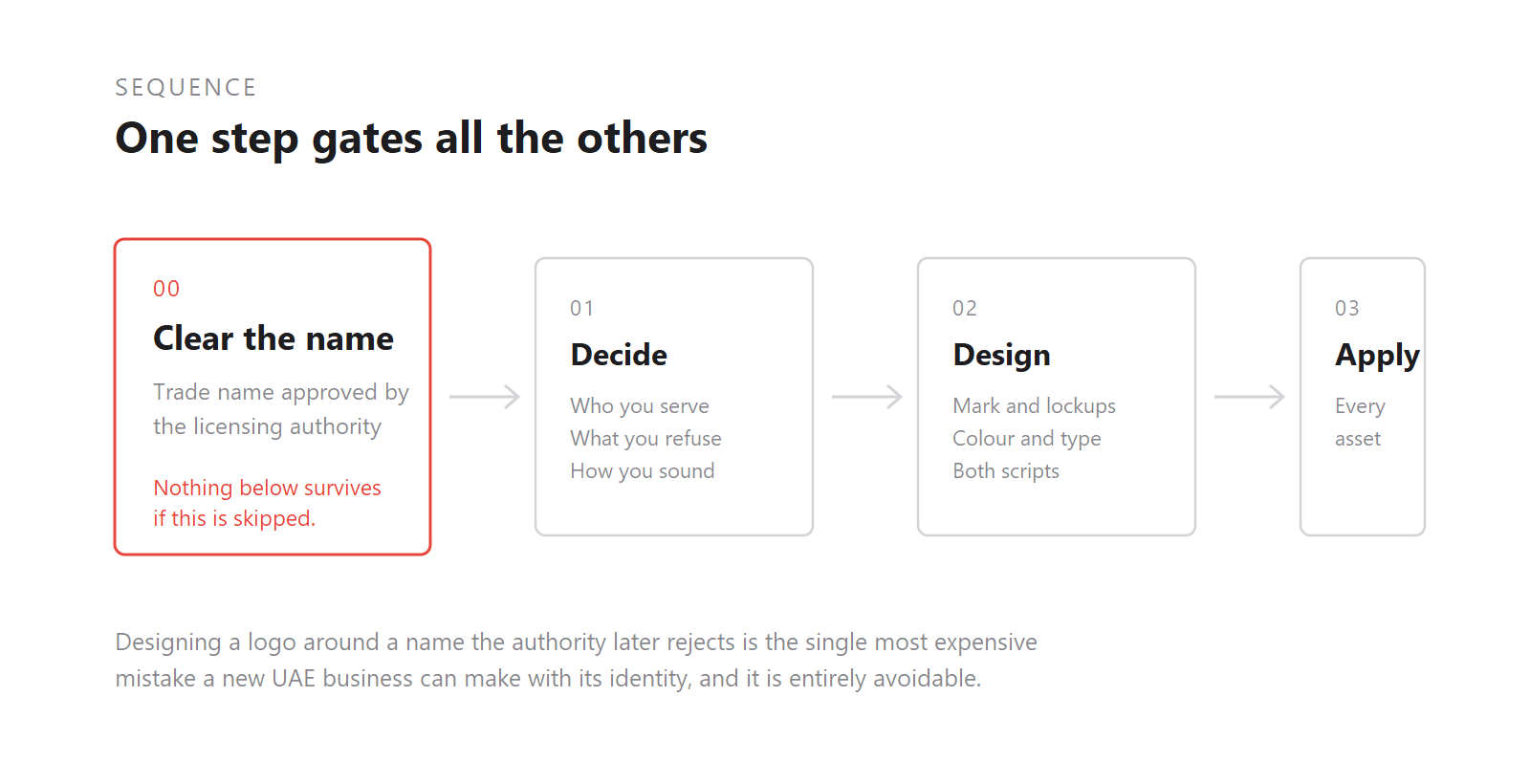
In most countries you pick a company name, check the domain, and move on. The UAE does not work that way.
Your trade name has to be approved and reserved by the licensing authority, the Department of Economic Development for mainland companies or the relevant free zone authority, before you can proceed with the licence, the company registration or visas. The Ministry of Economy and Tourism is the federal authority above that process.
The rules are more restrictive than founders expect. As reported by Khaleej Times, the requirements include the following.
| Rule | What it means in practice |
| The name must relate to the licensed activity | A name that says nothing about what you do can be refused |
| It must not already be registered | Check before you fall in love with it |
| It must carry the legal form | LLC or the equivalent forms part of the registered name |
| No names of Allah, government bodies, or third parties | Rules out a large set of otherwise appealing options |
| No improper wording, nothing against public sensibility | Judged locally, not by your home market |
| Dubai: no family or tribe names unless they are the licensee | Naming a company after someone else is not available |
| Names are taken literally, not translated | A clever translation does not create a different name |
Abu Dhabi adds its own conditions, including no icons or special characters, and a one-year wait before the name of a cancelled establishment can be reused. Confirm the specifics with your own authority rather than assuming Dubai rules apply everywhere.
The practical consequence is simple. Clear the name first. Everything visual depends on it, and nothing visual can be salvaged if it changes.
Sixteen items across four stages. Most brand identity checklists online start at the logo. This one does not, because in the UAE it cannot.
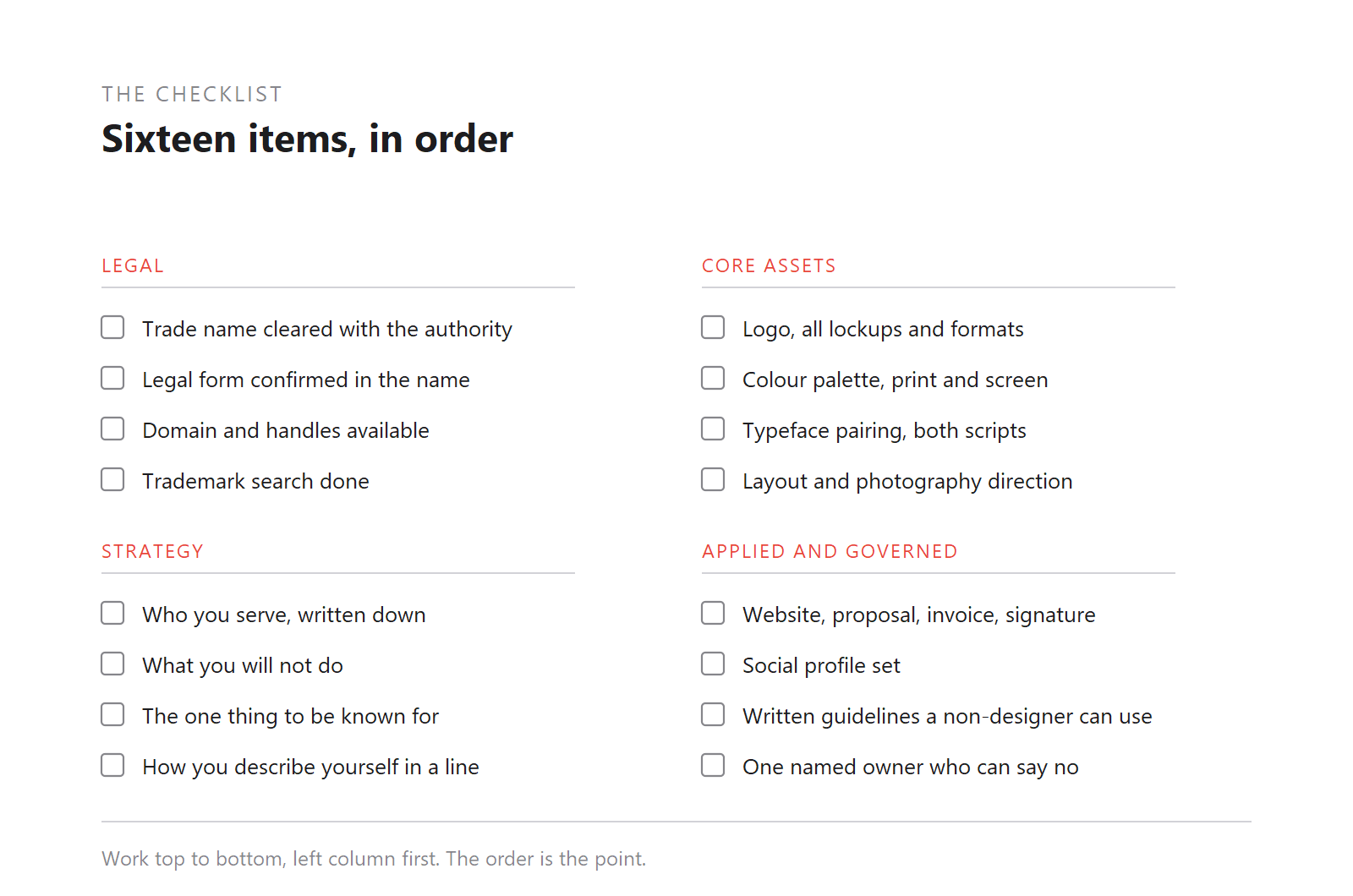
None of this is visual. This is brand strategy, written down in plain language, in a document a new hire could read.
A new company does not need a complete identity system in month one. It needs enough to trade credibly, and a plan for the rest.
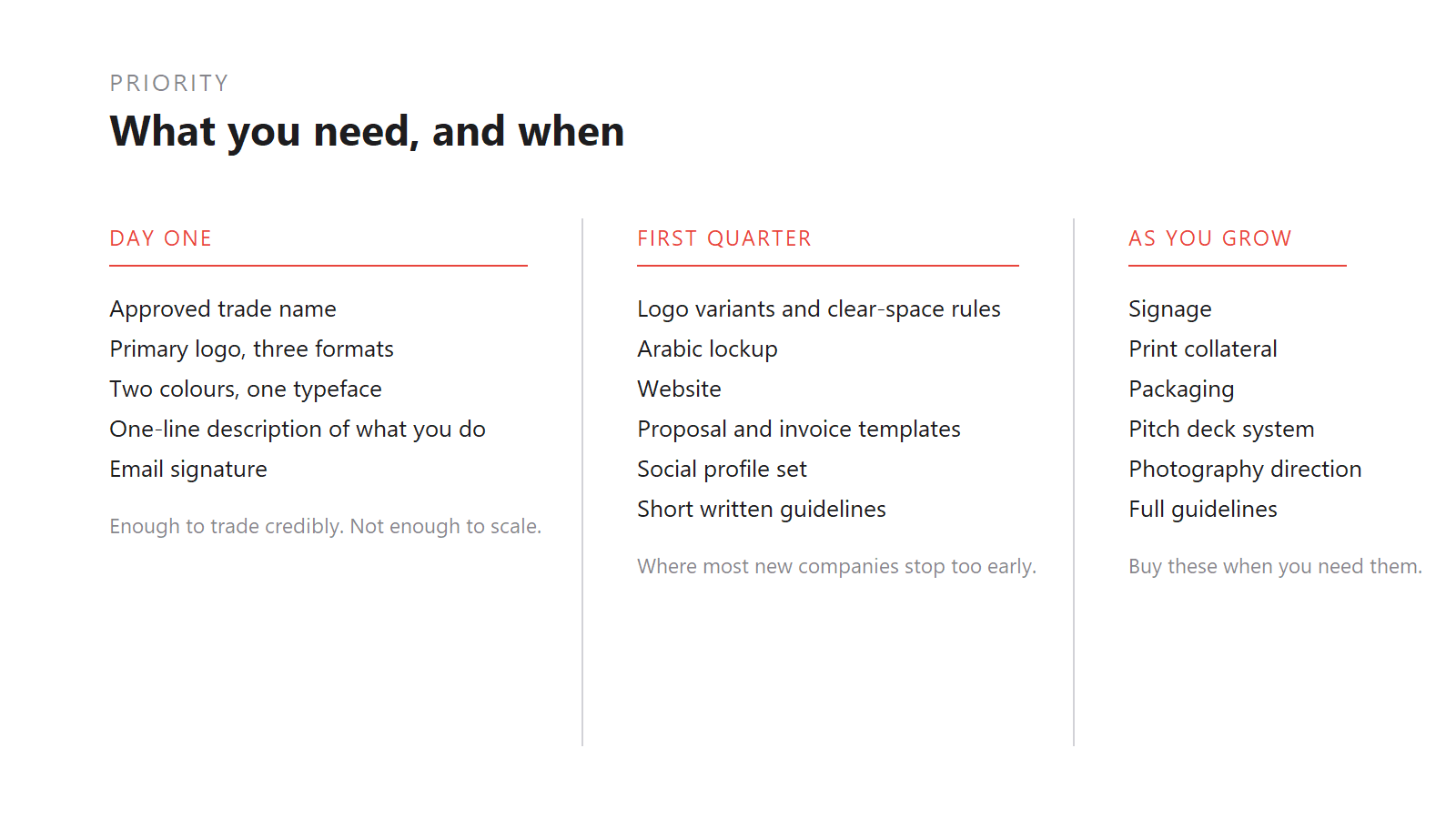
The risk at the day-one stage is underbuying in a way that traps you: a logo supplied as a single JPEG, no vector file, and a designer you cannot reach three months later. That is not a lean start, that is a rebuild with extra steps.
The risk in the first quarter is the opposite, which is stopping. The business is trading, the logo exists, and nobody writes the guidelines. Six months on, every deck looks slightly different and no single decision caused it.
Covered above, and worth repeating because it is the most expensive one on this list. Every hour of design work spent on an unapproved name is a bet.
Arabic changes reading direction, line length and vertical rhythm. A lockup designed in Latin script and then handed to a translator will look wrong the first time it goes on a wall, and walls are expensive to reprint. Design both together. The search implications are covered in Arabic SEO for UAE businesses.
A logo is one item in stage three of four. It is the most visible item, which is why it gets confused for the whole thing. On its own it gives you nothing to be consistent with.
Guidelines with no enforcer are a document, not a system. The owner does not have to be a designer. They have to be someone who is allowed to say no to a colleague in a hurry.
Two things make the UAE unusually unforgiving of a weak identity.
The first is that your audience has no shared context to fall back on. More than 200 nationalities live and work in the country, according to the Ministry of Foreign Affairs. Your next client, hire or investor may share no language and no prior knowledge of your category with you. Consistency is what replaces that missing context, and it is how trust gets built with people who have no other way to judge you.
The second is that people judge on surface quality far more than they will admit. In the largest study of its kind, Stanford’s Persuasive Technology Lab and Consumer WebWatch asked 2,684 people to assess the credibility of live websites, and "design look" appeared in 46.1 percent of the comments, ahead of every other factor. The paper is How Do Users Evaluate the Credibility of Web Sites? by Fogg and colleagues.
For a company with no track record yet, that judgement is most of what a stranger has to go on.
Anyone quoting before asking these questions is guessing.
Ask Us Anything!
Yes, and you should. The name has to be approved before licensing regardless, and approval is the gate that determines whether any design work is safe to start. Name first, always.
You submit an alternative. This is survivable if nothing has been designed yet and painful if it has. Prepare two or three names you would genuinely be happy with rather than one you are attached to.
Not necessarily on every asset, but the typeface and lockup decisions should account for it from the start. Retrofitting is what causes the visible problems, not the timing of the rollout.
No. Trade name approval lets you register and license the business. A trademark is separate protection for the mark itself. Clearing one does not clear the other, and both are worth checking before you commit.
The strategy stage, genuinely. Nobody can define who you serve and what you refuse better than you can. The legal stage needs the authority or a formation agent. The design stages need someone who can produce vector files and defend decisions.
An approved name, a logo suite in vector with a reverse version, two colours, one typeface pairing, one clear sentence describing what you do, and a consistent email signature. That is enough to look like a real business while you build the rest.
When the business changes. A new market, a new audience, a second brand or a genuine shift in what you sell are real reasons. Wanting something fresher is not, and your customers register recognition long before they register fashion.
The core identity should come first, because the website is an application of it rather than a replacement for it. If a site is urgently needed, a single landing page built on the day-one assets buys time. Whether a site or an app is the priority at all is covered in app or website first.
Corporate identity is the wider of the two. It is the visual, verbal and behavioural system that distinguishes a whole organisation, which older textbooks split into corporate design, corporate communication and corporate behaviour. Brand identity usually means the narrower toolkit, and it can belong to a single product. Branding is the ongoing process that shapes public perception and the customer relationship once either of them reaches the market. This checklist covers the wider scope, because a new company needs all of it.
Launching more than one brand means building brand architecture rather than a single identity, and it changes stage two. Decide early whether the parent company will be visible to customers or sit quietly behind the ventures. A corporate umbrella with distinct sub-brands underneath lets each one speak to its own buyer in its own voice. A multi-brand structure decided after the first logo is drawn is a rebuild, so raise it before any design starts.
We use cookies to help you navigate efficiently and perform certain functions. You will find detailed information about all cookies under each consent category below.
The cookies that are categorised as "Necessary" are stored on your browser as they are essential for enabling the basic functionalities of the site.
We also use third-party cookies that help us analyse how you use this website, store your preferences, and provide the content and advertisements that are relevant to you. These cookies will only be stored in your browser with your prior consent.
You can choose to enable or disable some or all of these cookies but disabling some of them may affect your browsing experience.