Corporate Identity vs Branding: The Real Difference, and Why It Matters More in the UAE



Corporate identity is the system you build: logo, colour, typography, tone, signage, templates, and the rules that keep them consistent. Branding is the result: what people believe about you after running into that system enough times. You build an identity. You earn a brand. Most companies buy a logo, call it both, and wonder why nothing changed.
Key takeaways
Walk one block through Business Bay and read the signage.
You will pass a company whose office sign uses one typeface, whose business card uses another, and whose Instagram grid looks like it was made by someone who had seen neither. The trade licence is real. The work might be excellent. But nothing in the way it presents itself suggests a business anyone has run for longer than a quarter.
That company has a logo. What it does not have is a corporate identity. And it has certainly not earned a brand.
The two terms get used as though they mean the same thing, usually by people selling one and delivering neither. They are not interchangeable, and the difference is not academic. It decides what you brief a designer to do, what you should be paying for, and what you can reasonably expect back.
Here is the distinction that holds up.
Corporate identity is the complete system a company uses to present itself and distinguish itself from competitors. Everything a stranger can see, read or experience, plus the rules that keep those things consistent when twelve different people are producing them.
Three words define the scope: visual, verbal, behavioural. Older textbooks split the same ground into corporate design, corporate communication and corporate behaviour. Either way, the point stands. Not a logo. A system.
Five layers make it up.
That last layer is the one people skip. It is also the one that decides whether the other four are believed.
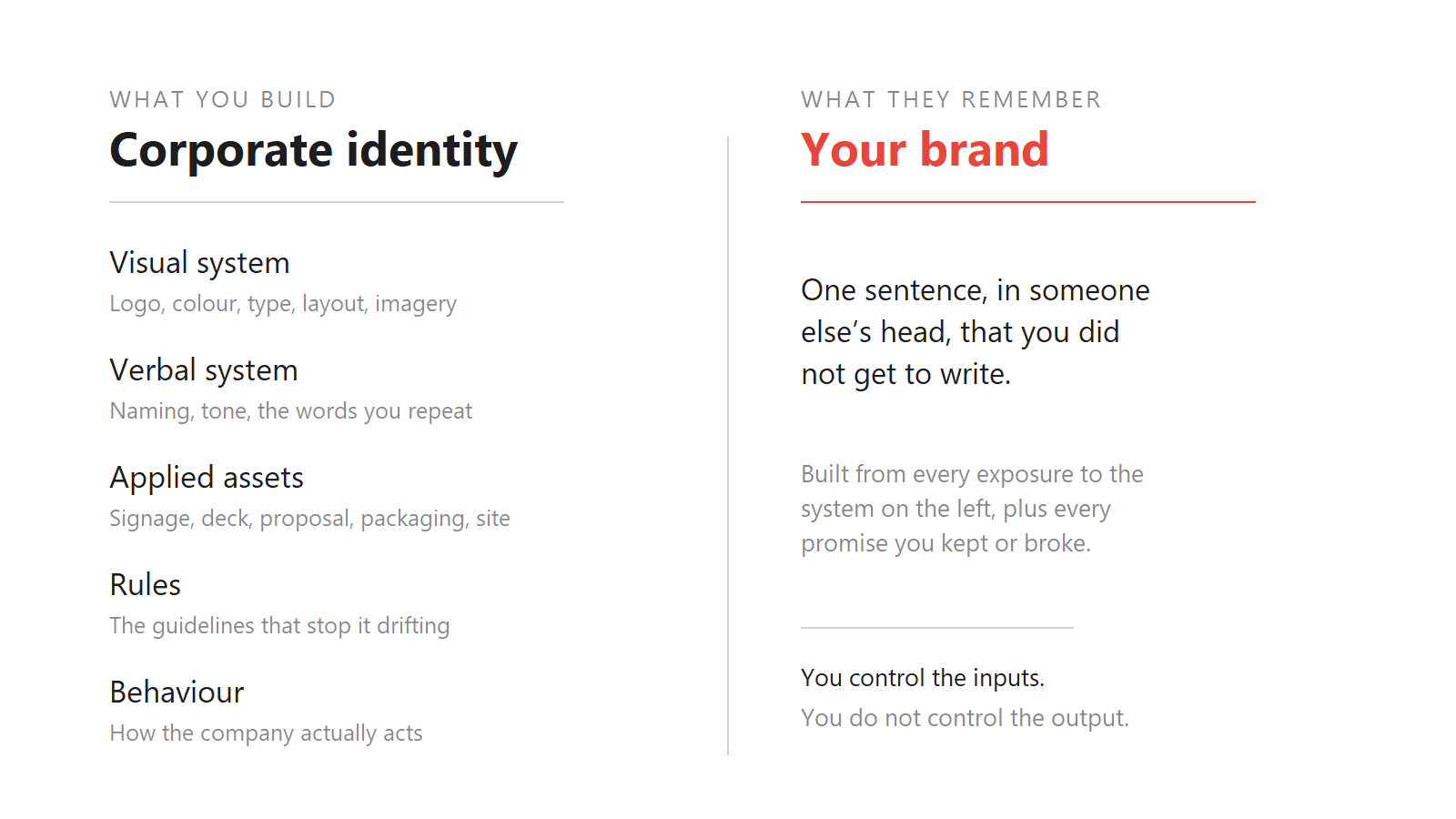
Branding is the ongoing process of shaping public perception: what people end up believing about your corporate brand. Corporate identity is what you produce. Brand is what your market concludes.
You control the first completely. You control the second not at all. You can only influence it, slowly, by being consistent long enough that people stop having to think about it.
Take McDonald’s. The corporate identity is easy to list: golden arches, a fixed red and yellow, near-identical store layouts across a hundred countries. The brand is something else entirely. Fast, cheap, predictable, safe to take children to. That promise is why a traveller who reads none of the local language will still walk in.
Redesign every store tomorrow and the brand survives. Break the promise once, publicly, on food safety, and no amount of design saves it.
That is the whole relationship. Identity is the input. Brand is the output. The output is held by other people.
If you only remember one row from this table, make it the second.
| Corporate identity | Brand | |
| What it is | A system you build | A belief other people hold |
| Who owns it | You | Your market |
| Scope | The whole organisation | Can be one product, service or the company |
| Audience | Staff, investors, partners, regulators, customers | Mainly buyers, though reputation leaks everywhere |
| Question it answers | Who are we | Why should I care |
| Speed of change | Slowly, and expensively | Slowly upward, very quickly downward |
| Proof it exists | A guidelines document, and assets that match it | People describe you the same way without being prompted |
This is the common one. A founder pays for a mark, receives three files, and considers the job finished. Six months later the deck, the signage and the website have each drifted in a different direction, because nothing defined how the mark was supposed to behave next to anything else.
A logo is the starting asset. Corporate identity design is the system that makes the logo mean something.
Arabic is not a translation layer you bolt on at the end. It changes reading direction, line length, vertical rhythm and the entire feel of a lockup. An identity designed only in Latin script will look improvised the first time it has to appear bilingually, which in this market is usually within the first month.
The fix is to design both scripts together from the start. We covered the mechanics of that in our guide to building bilingual Arabic and English websites in the UAE, and the search side of it in Arabic SEO for UAE businesses.
An identity without a named owner degrades by default. Someone needs the authority to say no to the sales manager who wants a slightly different blue for one deck. Without that person, and without a written standard behind them, consistency lasts about as long as the enthusiasm of whoever commissioned it.
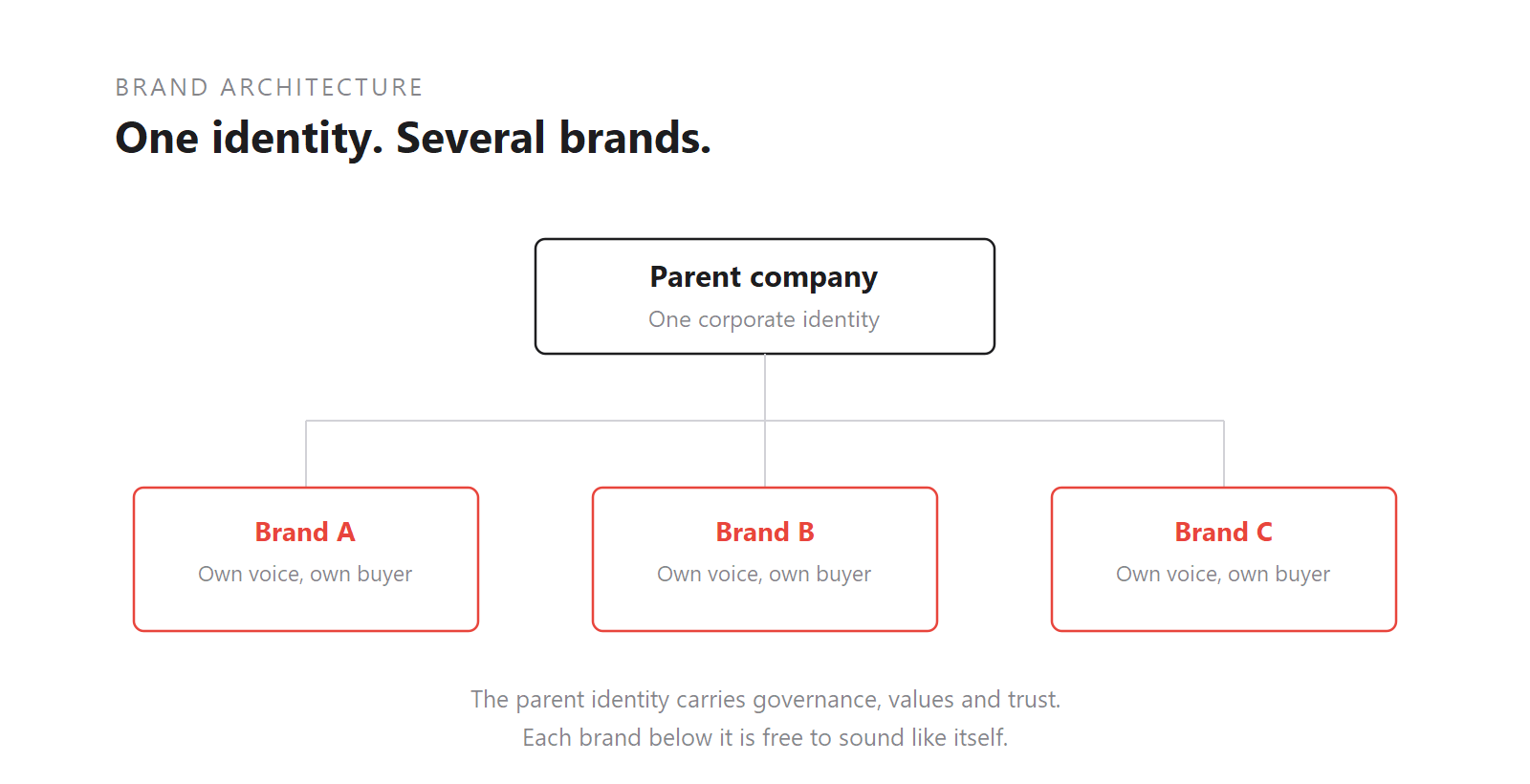
Yes, and at scale it is normal. The discipline has a name: brand architecture.
Alphabet operates one corporate identity above Google, YouTube and Waymo, each of which sounds and looks like itself. Closer to home, Majid Al Futtaim sits above Mall of the Emirates, VOX Cinemas and Ski Dubai. Nobody confuses the parent with the products, and that separation is the point.
The parent company identity carries governance, values and the trust that lets a new venture launch with credibility on day one. Each sub-brand sitting under that corporate umbrella is free to speak to its own buyer in its own voice. That is a multi-brand strategy working as intended.
What breaks is not having several brands. What breaks is having one brand that behaves like several because nobody wrote the rules down.
Three things make this market different, and all three raise the cost of getting identity wrong.
More than 200 nationalities live and work in the UAE, according to the Ministry of Foreign Affairs. Your next client, your next hire and your next investor may share no language, no cultural shorthand and no prior knowledge of your category.
Consistency is what replaces that missing context. When someone cannot read your reputation from your surname or your neighbourhood, they read it from your signage, your proposal and your website, and they do it fast.
In the largest study on the subject, Stanford’s Persuasive Technology Lab and Consumer WebWatch asked 2,684 people to evaluate the credibility of live websites and analysed what they actually mentioned. "Design look" appeared in 46.1 percent of comments, more than any other factor, ahead of information structure and information focus. The study is How Do Users Evaluate the Credibility of Web Sites? by Fogg and colleagues.
That was measured on websites, but the mechanism is not website-specific. People form a judgement from surface quality, then look for reasons to support it.
Lucidpress research on brand consistency, reported in 2019, found that consistent brand presentation was associated with revenue increases of up to 33 percent. Treat that as directional rather than a promise, since it is survey-based and self-reported. The direction is still the useful part: the cost of inconsistency is not only aesthetic.
Most failed identity projects fail because they start at step two.
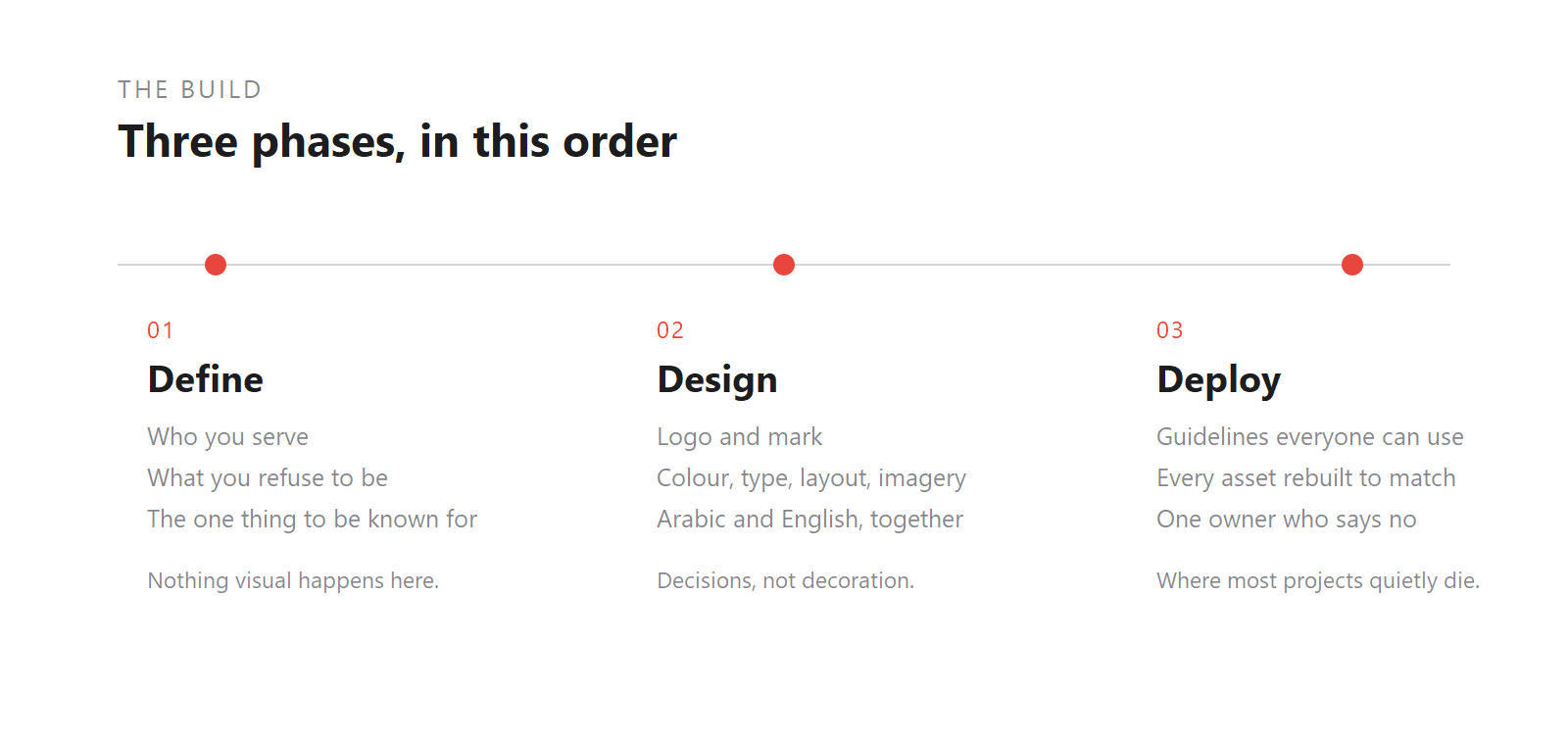
Nothing visual happens here. This is brand strategy, and it is the phase that gets skipped. You are answering three questions, in writing, in language a new employee could repeat.
If you cannot answer these, a designer will make the decisions for you, using guesswork, and you will be paying to find out whether the guess was right.
Now the visual elements get built: the mark, the palette, the typography, the layout logic, the photographic direction, the tone. Arabic and English developed side by side rather than sequentially.
The test for every decision is whether you can explain why. Decoration cannot be defended. Decisions can.
This is where most projects quietly die. Deployment means guidelines a non-designer can actually follow, every existing asset rebuilt to match, and one named person with the authority to reject work that does not.
A brilliant identity that lives in a PDF nobody opens is worth less than an ordinary one applied consistently everywhere.
Anyone quoting a number before asking these questions is guessing.
A credible studio will scope all of this before quoting rather than after. Ours is priced the same way, which you can see on our corporate identity design page.
Ask Us Anything!
Not quite, though the terms overlap heavily and many studios use them interchangeably. Corporate identity is organisation-wide and includes behaviour and culture. Brand identity is usually the narrower visual and verbal toolkit, and it can belong to a single product. If you are briefing an agency, agree the definition in writing before anyone quotes.
You need the parts that get seen: a consistent mark, one typeface pairing, a proposal template and a clear description of what you do. You do not need a fifty-page manual. Scale the system to the number of people who will use it.
It depends almost entirely on how fast you make decisions, not on how fast the designer works. Projects stall in approval, not production. Naming a single decision-maker at the start is the most reliable way to compress the timeline.
Refresh when the business changes, not on a calendar. A new market, a new audience, a merger or a genuine shift in what you sell are all real reasons. Boredom is not, and your customers notice recognition long before they notice fashion.
You can, and many companies do. Just be aware that a mark designed without a defined strategy is a mark designed on assumptions. If those assumptions turn out to be wrong, the logo is the first thing that has to change, and by then it is on your signage.
At minimum: the logo in all required lockups and file formats, a defined colour palette with print and screen values, a typographic system, layout principles, photographic direction, and a guidelines document written for people who are not designers. Anything less is a logo delivery, whatever the invoice calls it.
A freelancer is often the better choice for a focused mark and a light guideline set. An agency earns its cost when the project spans many assets, two scripts, several sub-brands and a rollout across existing touchpoints. Match the structure to the scope rather than to the budget alone.
It does, indirectly. Language models describe organisations using whatever is consistent and public about them. A company that describes itself the same way everywhere gives them something stable to repeat. A company that describes itself five different ways gives them nothing to hold on to.
A corporate identity has five key elements: the visual system, the verbal system, the applied assets, the written rules, and corporate behaviour. As deliverables that means a logo suite, a colour palette, a typography system, layout and photography direction, and a guidelines document. It is the unique combination of these that makes a company recognisable, not any single one of them.
They describe the same company from two directions. Corporate identity is the tangible side: the structural rules and visual tools an organisation uses at an institutional level. Branding is the emotional side: the customer relationship and the impression that accumulates over time. One is what you can hand to a designer. The other is what you cannot.
Discovery is where strategy gets written down before anything is designed. A studio should come out of it with your mission statement, your brand vision, your brand values, and a clear account of who you serve and who you do not. A project that skips discovery and goes straight to design is a project where the designer is guessing at all four.
We use cookies to help you navigate efficiently and perform certain functions. You will find detailed information about all cookies under each consent category below.
The cookies that are categorised as "Necessary" are stored on your browser as they are essential for enabling the basic functionalities of the site.
We also use third-party cookies that help us analyse how you use this website, store your preferences, and provide the content and advertisements that are relevant to you. These cookies will only be stored in your browser with your prior consent.
You can choose to enable or disable some or all of these cookies but disabling some of them may affect your browsing experience.