Restaurant Marketing in Dubai: What the Numbers Actually Say



Dubai has roughly 26,000 food establishments and added 1,500 in five months. Delivery platforms now convert 41 percent of what your customers spend into their own revenue, and the fastest-growing slice of that is advertising, not commission. Restaurant marketing in Dubai is the work of building demand you own rather than renting it back every month.
Most restaurant marketing advice is written for a market that does not look like this one. It assumes a town with a handful of competitors, a customer base that lives nearby all year, and a delivery app that takes a fixed cut and leaves you alone. None of that describes Dubai.
This guide uses published numbers rather than industry folklore. Every figure is linked to its original source, and where a number is commonly repeated but cannot be traced, it is left out.
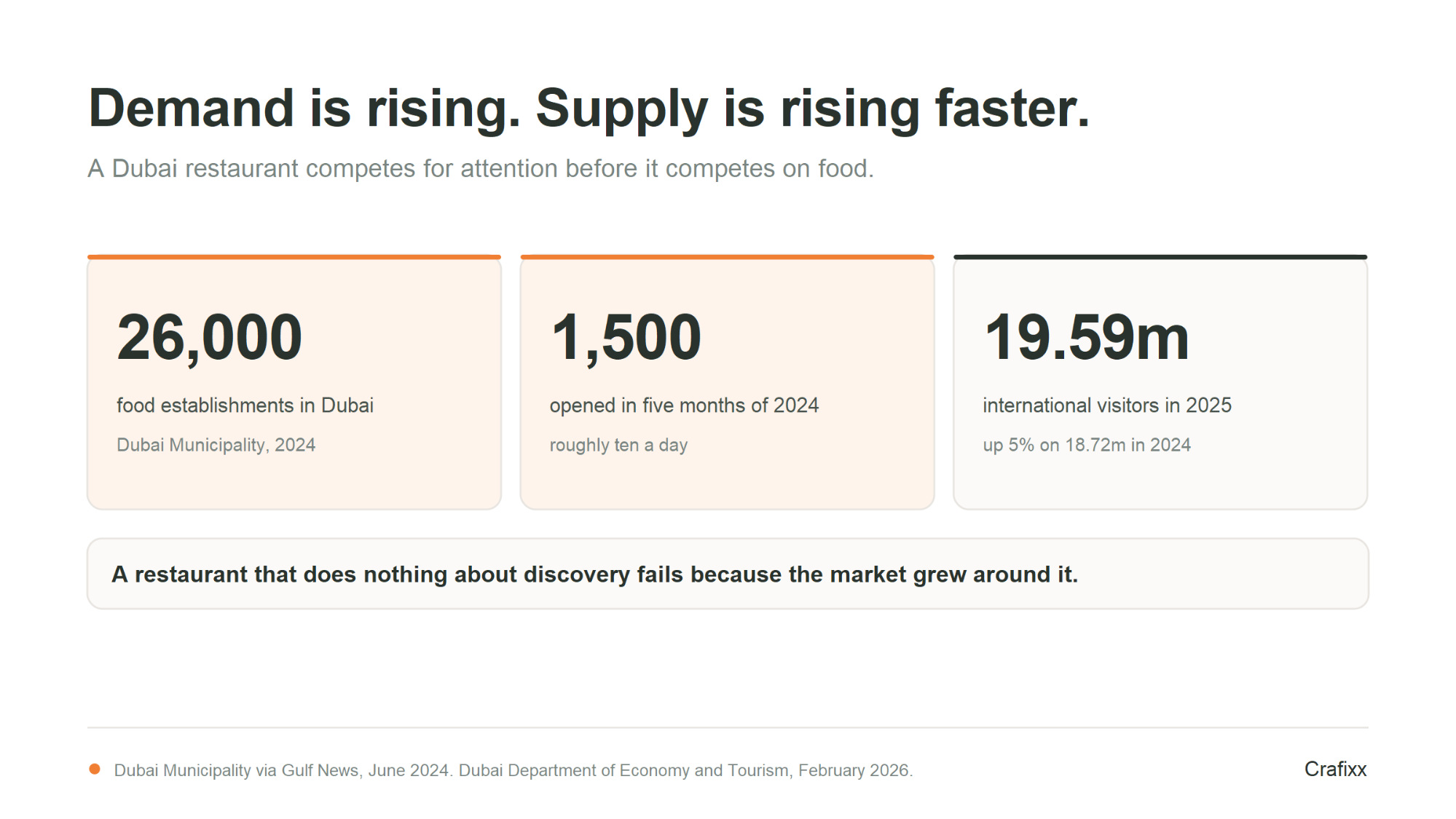
It can be, but the constraint is rarely the food. Dubai's Food Safety Department put the emirate at 26,000 food establishments, with 1,500 of those opening in the first five months of 2024 alone. In a market adding roughly ten new competitors a day, the binding constraint is whether anyone can find you, not whether the kitchen is good.
Those figures come from Sultan Al Taher, Director of the Food Safety Department at Dubai Municipality, reported by Gulf News in June 2024. They are worth sitting with. A new opening is not an event in Dubai. It is Tuesday.
The demand side is genuinely strong. Dubai recorded 19.59 million international overnight visitors in 2025, up 5 percent from 18.72 million in 2024, according to the Dubai Department of Economy and Tourism, published by the UAE Government Media Office in February 2026. That is a third successive record year.
Put the two numbers together and the picture is specific. Demand is rising. Supply is rising faster and from a much larger base. A restaurant that does nothing about discovery does not fail because the market shrank. It fails because the market grew around it.
More than most owners think, and not mostly through commission. Talabat is listed on the Dubai Financial Market, so its economics are now public. In its financial year 2025 the platform turned 41 percent of everything customers spent through it into its own revenue, up from 40 percent the year before.
The detail matters more than the headline. From Talabat Holding plc's Q4 2025 results, published 13 February 2026, the full-year revenue splits like this:
| Revenue line | FY 2025 (USD m) | FY 2024 (USD m) | Change |
| Commission fees | 1,297 | 1,062 | +22% |
| Subscription fee and other income | 1,397 | 952 | +47% |
| Delivery and service fees | 859 | 696 | +24% |
| Advertising and listing fees | 323 | 246 | +32% |
| Total management revenue | 3,876 | 2,956 | +31% |
| Gross merchandise value | 9,421 | 7,428 | +27% |
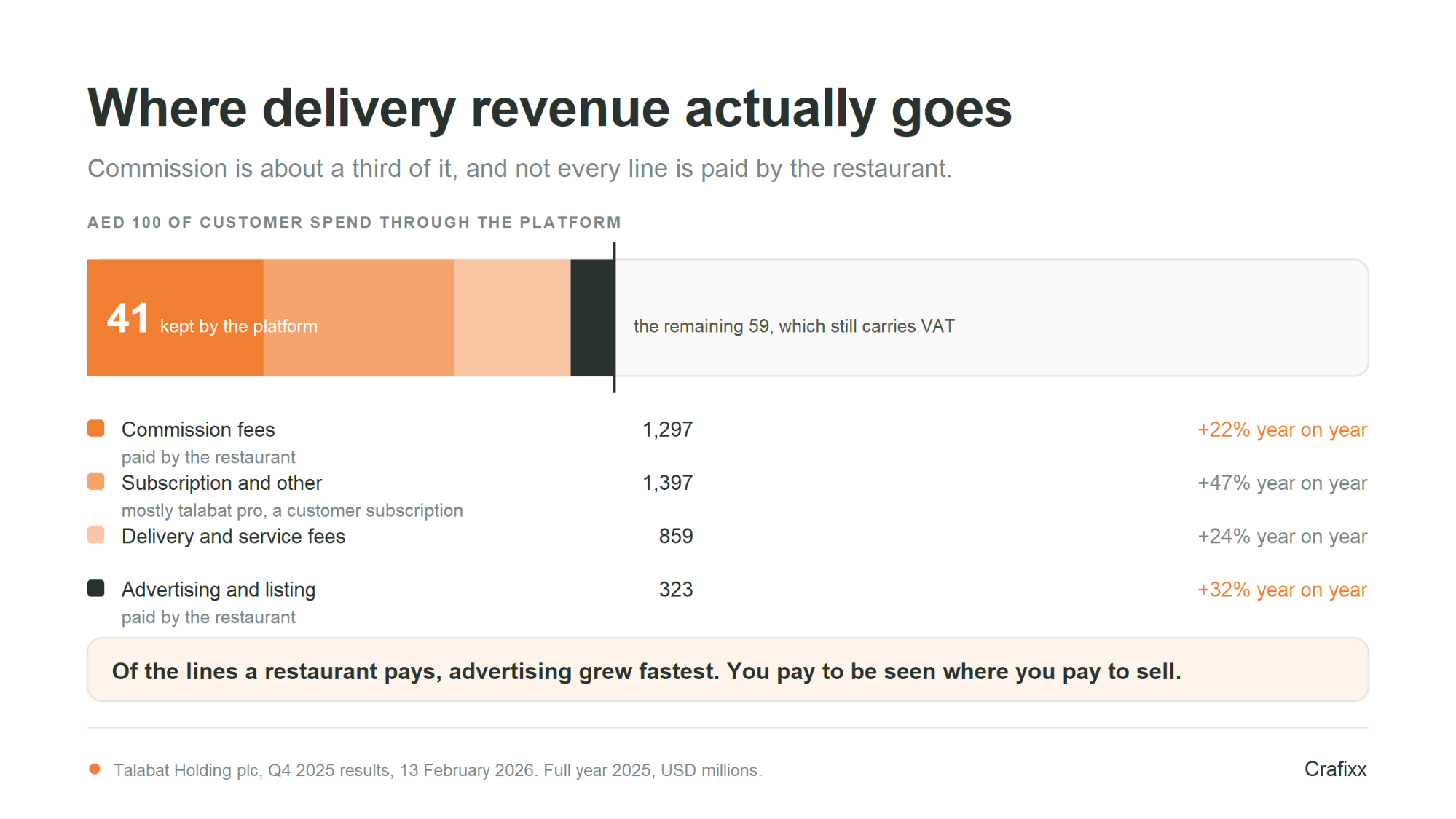
Commission is about a third of what the platform earns. The other two thirds come from subscriptions, delivery and service fees, and advertising. Arguing only about your commission percentage means arguing about a third of the problem.
One point of fairness, because the filing is explicit about it. Talabat states that the higher conversion ratio "mainly reflected a higher share of talabat mart and subscription revenues that more than offset lower commission rates." Commission rates went down. The platform's total take still went up. That is the mechanism worth understanding, and it is not the same as accusing anyone of raising prices.
Because visibility inside the app is now something you buy separately. Of the revenue lines a restaurant itself pays, advertising and listing fees grew fastest in Talabat's 2025 results, up 32 percent to USD 323 million against 22 percent for commission. That is restaurants paying to be seen on a platform they are already paying to sell through.
One line grew faster still, and it is worth separating out. Subscription and other income rose 47 percent, but that is mostly talabat pro, a customer loyalty subscription, so it is money from diners rather than from you. The line that is unambiguously yours, and rising, is advertising.
This is the part generic advice misses. Listing on an aggregator used to be a distribution decision. It has become a distribution decision plus an ongoing media buy, because a listing that nobody scrolls to is not distribution at all. The moment your competitors start bidding for placement, standing still costs you position.
None of that makes aggregators a mistake. They deliver real volume, real reach and real convenience, and for a new venue they can fill a room faster than anything you build yourself. The mistake is treating them as your marketing rather than as one channel inside it, because a channel where visibility is auctioned is a channel where your cost rises with your competitors' budgets and not with your own performance.
Owned channels are the ones where reaching your customer again costs you nothing extra. Rented channels are the ones where reaching the same customer twice means paying twice. Most Dubai restaurants are heavily weighted toward rented, usually without having decided to be.
| Channel | Owned or rented | |
| Delivery aggregator listing | Rented | Commission again, and increasingly placement spend |
| Paid social | Rented | Full media cost again |
| Organic social following | Rented, though it feels owned | Nothing, but reach is set by the platform, not by you |
| Your Google Business Profile | Mostly owned | Nothing, and it is where "restaurants near me" resolves |
| Your website and direct ordering | Owned | Nothing beyond hosting |
| Your customer list, email or WhatsApp opt-in | Owned | Nothing, and it survives any platform change |
| The room itself and the menu in it | Owned | Nothing, and it is the only channel every guest sees |
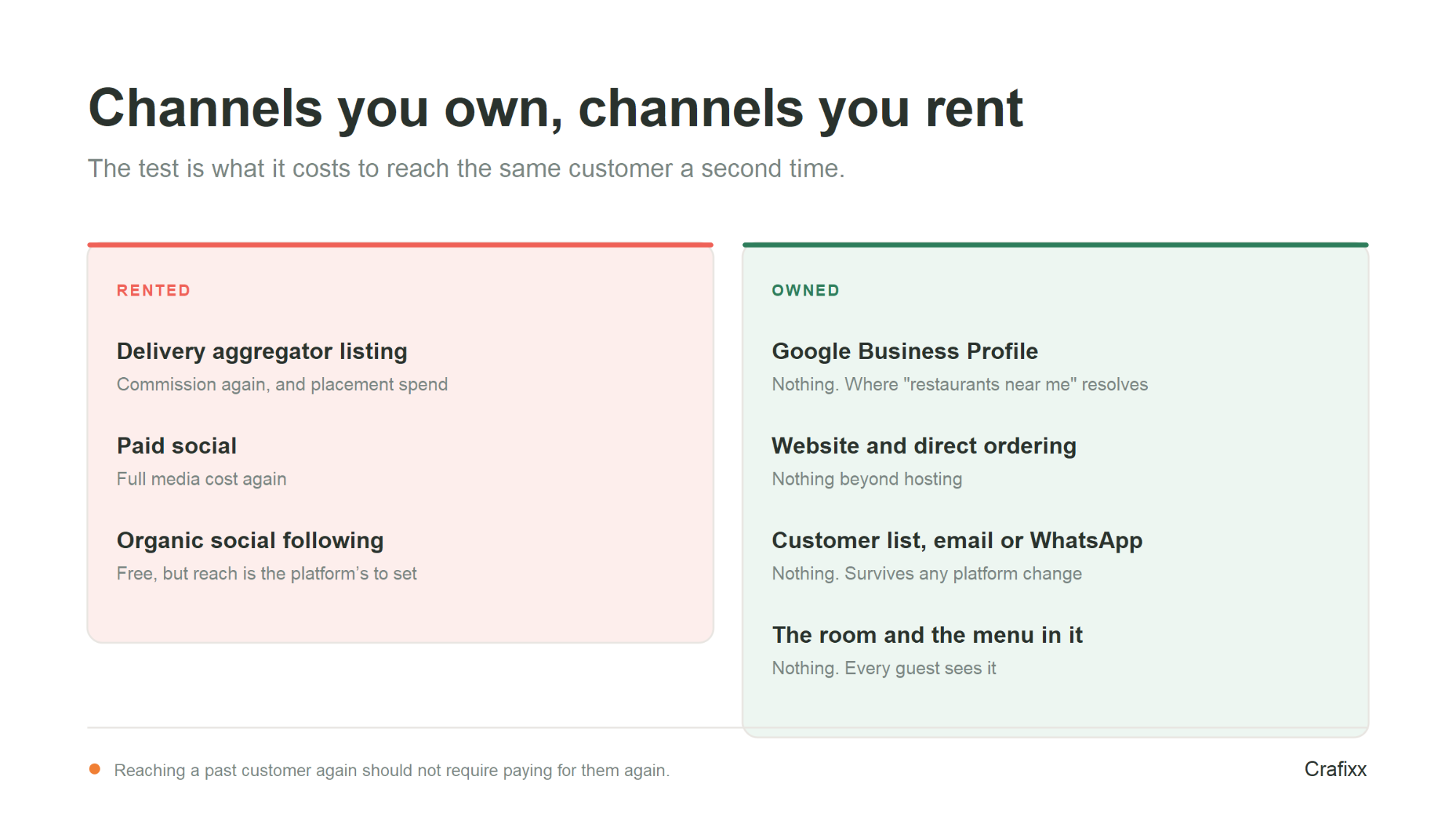
The point is not to abandon rented channels. It is to notice that a restaurant with no owned channel has no way to bring a guest back except by paying for them a second time. That is a structural position, not a marketing tactic, and it is decided long before anyone writes a caption.
In rough order of how reliably it works, and how few restaurants do it properly: local search presence, the menu itself, repeat visits from people who already came, and only then paid reach. The order matters more than the list, because effort spent at the bottom without the top is effort spent renting attention you cannot keep.
Local search presence. When someone in Dubai Marina opens Maps and searches for a cuisine, the result is decided by your Google Business Profile: category, hours, photographs, review volume and how recently anything changed. It is free, it is owned, and it is where intent is highest, because the person searching has already decided to eat. Keeping it accurate and active is ordinary local SEO work, and it is probably the highest-return hour a restaurant can spend.
The menu. Every guest reads it, which makes it the highest-circulation piece of marketing you will ever produce, and it is usually the piece nobody treats as marketing at all. More on this below.
Repeat visits. A returning guest costs nothing to acquire. The mechanics are unglamorous: a reason to come back, a way to contact people who opted in, and a room that was worth returning to. This is where owned channels pay for themselves.
Paid reach. It works, it is fast, and it stops the moment you stop. Useful for an opening, a genuinely new offer or a seasonal push. Weak as a permanent substitute for the three above.
Two tactics deserve naming as weaker than their reputation. Discount-led promotion trains a price-sensitive audience to wait for the next discount, and in a market with 26,000 alternatives there is always a next discount somewhere. Follower-count campaigns buy a number that does not correlate with covers, because reach on a rented platform is not attention you own.
The menu is the only marketing that reaches 100 percent of your guests, decides what they order, and therefore sets your margin per cover. Treating it as a typesetting job rather than a commercial one leaves money on every table, and unlike paid reach it costs nothing extra once it is right.
There is a whole discipline here, covering which dishes to promote, how to price when VAT is inclusive, and which layout tactics survive testing and which are folklore. The thinking is in our guide to menu engineering. The execution is a menu design job rather than a printing one, because the layout is what does the work.
The connection to this article is simple. Every other channel on the list is about getting someone to the table. The menu is the only one that changes what happens once they arrive.
Dubai's customers do not all read English, and a venue that presents itself only in English is choosing which half of the room it speaks to. This is a positioning decision that gets treated as an admin task, usually by running the menu and the website through machine translation and hoping.
The same applies to being found. Arabic search is not English search with substituted words, and the tools most agencies use systematically under-report Arabic demand. If a meaningful share of your guests search in Arabic, that is covered in our guide to Arabic SEO for UAE businesses, and the build side is in our guide to multilingual website design.
Reach, impressions and follower counts tell you how many people a platform showed something to. None of them tell you whether a table was filled. The measures below are harder to collect and considerably harder to fake.
Pick two. A restaurant that genuinely tracks repeat rate and channel mix will make better decisions than one with a dashboard of thirty metrics nobody acts on.
Most of the highest-value work here is in-house work. Your Google Business Profile, your review flow, your menu and your customer list all need someone inside the business who owns them, because they depend on operational detail an outsider does not see day to day.
Outside help earns its place on the pieces that need craft rather than presence: the brand identity, the menu as a designed object, the website and direct ordering, the Arabic. Those are project-shaped, not daily. If you are weighing up a restaurant marketing agency in Dubai, the useful question is not what they will post, but which of the owned channels above they will leave you actually owning at the end.
The honest test is the one you can apply to any proposal. If the work stops and the results stop the same week, you rented something. If the work stops and the results decay slowly, you built something.
Ask Us Anything!
More than the commission line suggests. Talabat's published 2025 results show management revenue equal to 41 percent of gross merchandise value, up from 40 percent, with commission fees making up about a third of that total. The rest is subscriptions, delivery and service fees, and advertising. Your own contract terms will differ, but the platform-level economics are public.
Usually not. They deliver genuine volume and reach that is hard to replicate, especially for a new venue. The realistic goal is not to leave but to stop being entirely dependent, by building at least one owned channel so that reaching a past customer again does not require paying for them again.
A properly maintained Google Business Profile, followed by a menu that is designed rather than typeset. Both are free or already paid for, both reach people at the moment they are deciding, and both are owned. Most venues do neither well, which is why the return on doing them properly is high.
Dubai Municipality's Food Safety Department reported 26,000 food establishments in the emirate, with 1,500 opening in the first five months of 2024. That is the competitive set for attention, though not all of them compete with you on cuisine or location.
No, because organic reach on any social platform is set by the platform, not by you. It is a useful channel for showing what a room feels like, and a poor one to rely on for repeat business, since you cannot contact your own followers without the platform's permission.
Yes, for two reasons that have nothing to do with looking professional. It is where local search sends people who are checking you out before booking, and it is the only place you can take a direct order or capture an opt-in. Without it, every customer relationship you have is held by someone else.
We use cookies to help you navigate efficiently and perform certain functions. You will find detailed information about all cookies under each consent category below.
The cookies that are categorised as "Necessary" are stored on your browser as they are essential for enabling the basic functionalities of the site.
We also use third-party cookies that help us analyse how you use this website, store your preferences, and provide the content and advertisements that are relevant to you. These cookies will only be stored in your browser with your prior consent.
You can choose to enable or disable some or all of these cookies but disabling some of them may affect your browsing experience.