SEO vs GEO: Do You Really Need to Rebuild Your Website for AI?



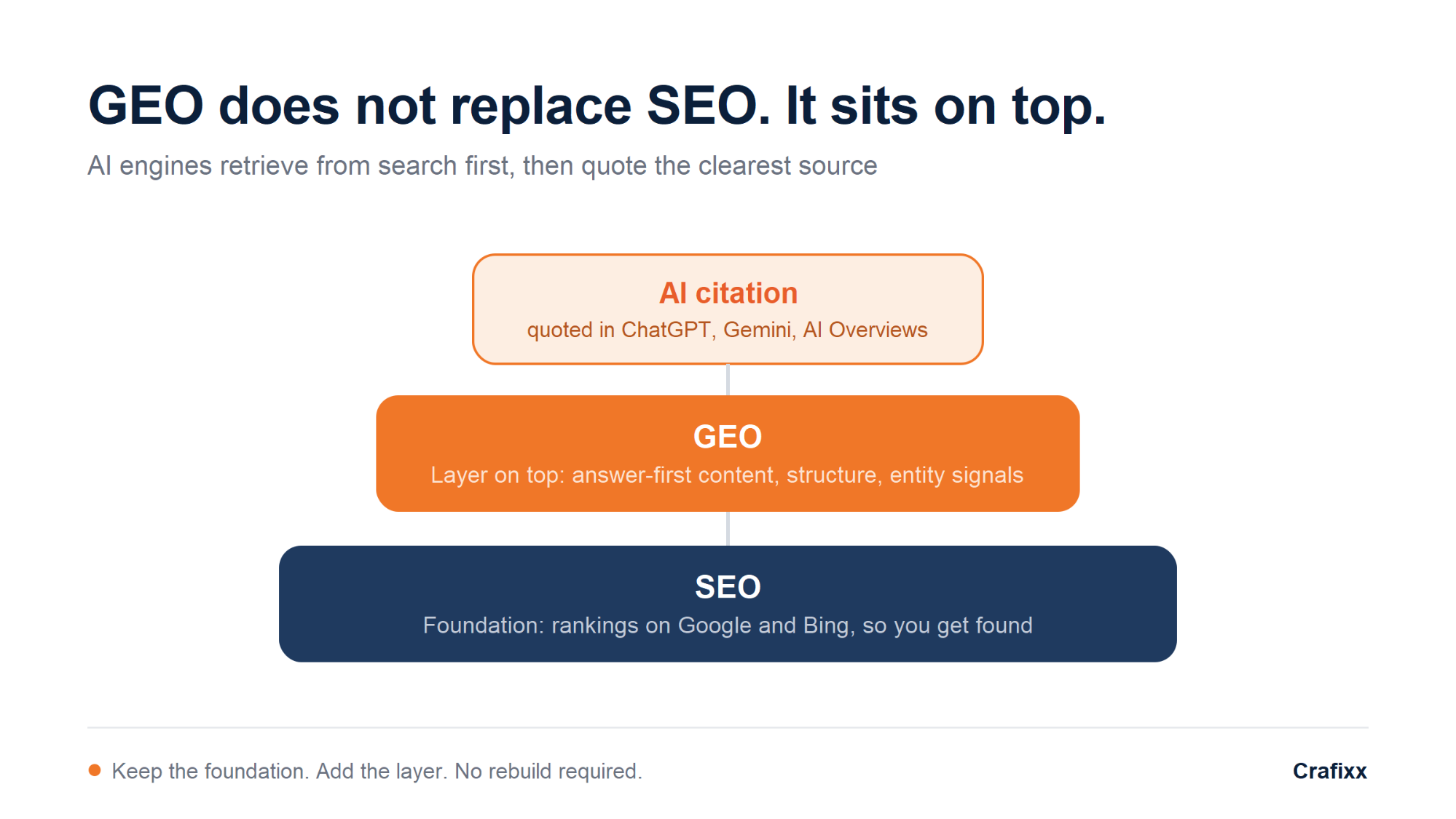
No, you almost never need to rebuild. SEO, AEO and GEO are layers, not rivals. Keep your SEO foundation and add answer-first content, clean structure and strong entity signals so AI engines can quote you.
Search is changing faster than most business owners realise. In 2026, Google confirmed that its AI Mode passed one billion monthly users just a year after launch, with queries more than doubling every quarter (Google). Answers, not links, are becoming the destination.
That shift triggers a familiar panic: does my website need to be rebuilt for AI? The short answer is no, and this guide covers the full picture. What actually changed, how the terms SEO, AEO and GEO fit together, how AI engines really choose what to cite, what Google itself says, what moves the needle, and where a Dubai business should start.
Search is becoming answer-first, and fast, but that raises the value of your content rather than making your website obsolete.
These numbers describe a new surface, not a dead website. The pages you already own are the raw material AI engines quote from, if they are easy to read and trust.
Search has moved from ten blue links to direct answers over about two decades, and every step added a layer on top of SEO rather than replacing it.
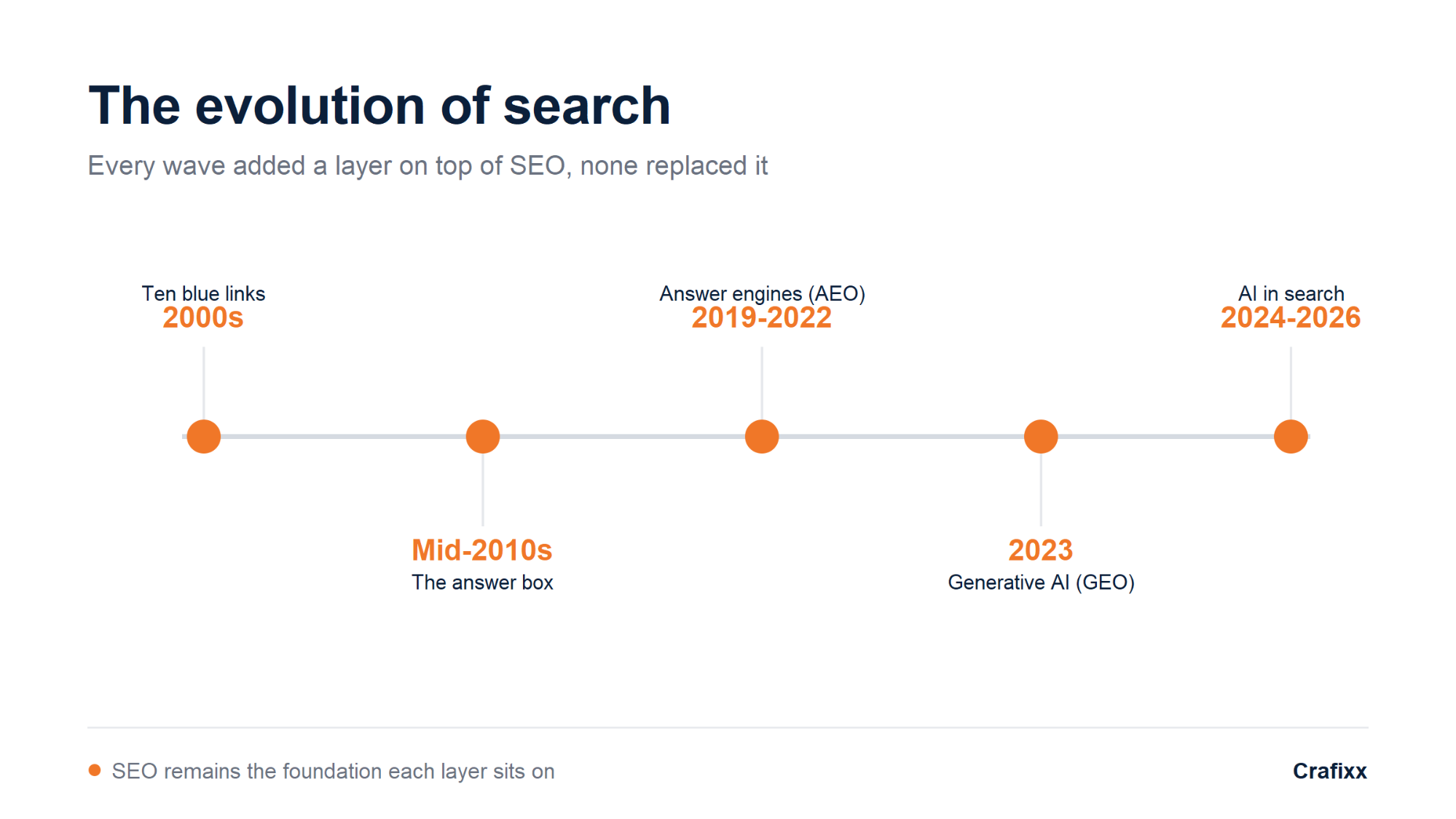
The pattern is the theme of this guide. Each wave sat on top of solid SEO. None of them threw it away.
They mostly describe the same goal, being found and chosen. SEO is the durable umbrella. AEO, GEO, AI SEO and LLM SEO are competing labels for the newer AI-answer layer, and even the experts do not fully agree on them yet. Here is where each came from and what the leaders actually say.
| Term | Origin | Where it stands in 2026 |
| SEO | 1990s | The umbrella term. Here to stay. |
| AEO (answer engine optimization) | Grew with snippets and voice search | Widely used for the answer layer. |
| GEO (generative engine optimization) | A 2024 Princeton research paper | Fast-rising and academically grounded. |
| AI SEO | Industry marketing term | Popular, but loosely defined. |
| LLM SEO | Industry marketing term | Same idea as GEO, less common. |
Google gives the clearest anchor. Its Search Liaison, Danny Sullivan, put it plainly: optimising for generative AI search is "optimising for the search experience, and thus still SEO" (Google Search Central, 2026). Google's official guidance treats AEO and GEO as part of SEO, not separate jobs.
The term GEO was coined in a 2024 research paper from Princeton and collaborators (arXiv), which is why it carries academic weight that "AI SEO" and "LLM SEO" do not.
Practitioners are split, and that is the honest picture. Aleyda Solis, a widely followed SEO consultant, frames the change as the profession evolving into "findability" across a more diverse search landscape. Rand Fishkin of SparkToro argues the sharper point that simply getting better at classic SEO is not enough when engines hand out fewer clicks. Others read GEO differently again: Lily Ray sees it as strong E-E-A-T done well, while Mike King treats it as an engineering discipline. For a neutral overview of the terms and their origins, see the Wikipedia entry on generative engine optimization.
Keep SEO as the umbrella, and use GEO or AEO for the AI-answer layer. Do not chase acronyms.
The practical takeaway for a Dubai business: ignore the label war. Do solid SEO, then add the AI-answer layer on top. That is the whole game, whatever you call it.
SEO, AEO and GEO are not rivals, they stack. SEO gets you retrieved, AEO gets you quoted as the answer, and GEO gets you cited and recommended inside AI answers.
A page has to rank to be retrieved, then be structured well enough to be quoted, then carry enough trust to be recommended. Each layer sits on the one below, which is exactly why a sound site adds to what it already has rather than starting over. This is the heart of modern AI SEO.
No. SEO is the foundation the others stand on, because an AI engine cannot quote a page it never retrieved, and retrieval still depends on search rankings.
What changed is the destination, not the discipline. The answer, not only the blue link, is now where attention lands. Ranking still matters, it just is not the finish line anymore.
Almost never. If your site is technically sound and allows AI crawlers, AEO and GEO are additions, not a rebuild. You optimise what you have.
A full rebuild is only worth considering if your current site is genuinely broken: it blocks crawlers, is painfully slow, or is built so rigidly that clean headings and structured content cannot be added. That is a foundation problem, not an AI problem. For most businesses, the fix is editing, not rebuilding.
Google's own 2026 guidance is that the same SEO best practices apply to its AI features, and that you do not need special markup, an llms.txt file, or content rewritten for AI.
Google states that its generative AI features in Search are rooted in its core Search ranking and quality systems, so strong SEO is what positions a site for them (Google Search Central). It says plainly that you do not need special files like llms.txt, content chunking, or AI-only rewriting, and that optimising for generative AI search is optimising for search, and thus still SEO. That is about as clear a signal as you can get that a sound site does not need rebuilding for AI.
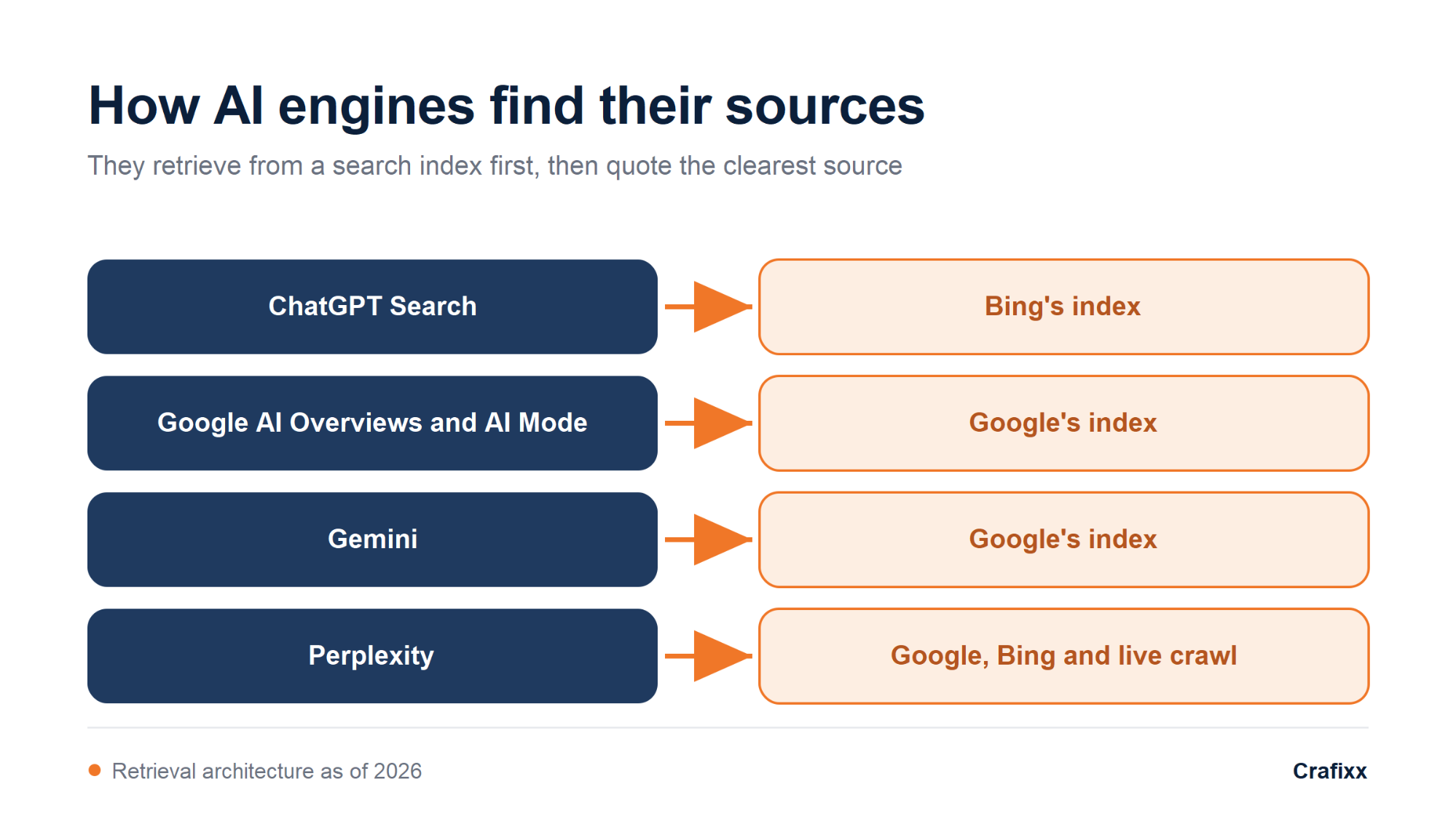
They retrieve from a search index first, then quote the clearest, most trustworthy source. So where you rank still decides whether you can be quoted.
| Engine | Where it retrieves from |
| ChatGPT Search | Leans on Bing's index |
| Google AI Overviews and AI Mode | Google's index |
| Gemini | |
| Perplexity | Blends live crawling with both |
Miss any one and your page is read, but not cited.
Five levers, and all of them are edits to a site that already ranks, not a teardown.
The same five levers work in every sector. Only the questions your customers ask an AI change.
None of these examples needed a rebuild. Each is the same approach, pointed at the questions that industry's customers actually type into an AI. That is the practical version of everything above.
AEO is still early in the UAE, which is exactly why it is worth acting now. Local demand is small today, global demand is rising fast, and citation habits compound.
The businesses that structure for AI now become the sources models trust before the local market catches up. Waiting is the expensive option.
Most of what slows businesses down is a myth, not a technical wall.
You cannot track AI citations like keyword rankings, so use a different toolkit.
You can get most of the way there by editing your existing site.
Ask Us Anything!
SEO earns rankings at the page level. AEO earns the extracted answer in snippets and AI Overviews at the fact level. GEO earns citations inside generative AI answers like ChatGPT and Gemini. They stack, and you need all three.
Almost never. If your site is technically sound and allows AI crawlers, AEO and GEO are additions, not a rebuild. You optimise the content and structure you already have.
Yes. AI engines retrieve from search results before they answer, so ranking is still what gets you found. SEO is the foundation AEO and GEO depend on.
AEO is structuring your content so answer engines can understand, trust and quote it as the direct answer, using clear answers, clean structure and strong trust signals.
Not entirely, but it is changing how results appear. Google's own AI Mode passed a billion monthly users in a year, so the smart move is to be visible in both classic results and AI answers.
It helps a lot. ChatGPT Search leans on Bing's index, so ranking on Bing as well as Google widens your reach into AI answers.
It builds over months, not days, because entity trust and citations compound. Starting early in a market like the UAE is the advantage, not a quick win.
We use cookies to help you navigate efficiently and perform certain functions. You will find detailed information about all cookies under each consent category below.
The cookies that are categorised as "Necessary" are stored on your browser as they are essential for enabling the basic functionalities of the site.
We also use third-party cookies that help us analyse how you use this website, store your preferences, and provide the content and advertisements that are relevant to you. These cookies will only be stored in your browser with your prior consent.
You can choose to enable or disable some or all of these cookies but disabling some of them may affect your browsing experience.