App or Website First? A Dubai Founder's Guide to Spending Your First Dirham Right



Build a website first. It wins discovery and trust from day one. Add a mobile app later, once real repeat use justifies it. If you are launching a business in the UAE, this question shows up early and it is stressful. Your budget is finite, everyone has an opinion, and the wrong first move can burn a large part of your first marketing budget on something customers do not need yet.
This guide gives you a calm, practical way to decide. No hype, just how the two options actually work, what the numbers say, and a simple framework you can apply to your own business today.
Direct answer: Because they look like the same purchase but are not. Both cost real money, so it feels risky to pick wrong, when in truth they solve different problems at different stages.
Both a website and an app cost real money, and both take time to build. So the fear is reasonable: what if I pour the budget into the wrong one?
The trap is treating them as the same kind of thing. They are not. They solve different problems at different stages of a business. Once you see what each one is actually for, the choice usually makes itself.
Direct answer: A website is your front door. It is how new customers discover you, judge whether to trust you, and reach you.
It is the one place every prospect checks before they decide, whether they found you on Google, an AI chatbot, Instagram or a referral.
For almost every new business, this is the layer you cannot skip. It is the reason strong web design and web development come first.
Direct answer: An app is not a front door, it is a loyalty tool for people who already chose you and come back often.
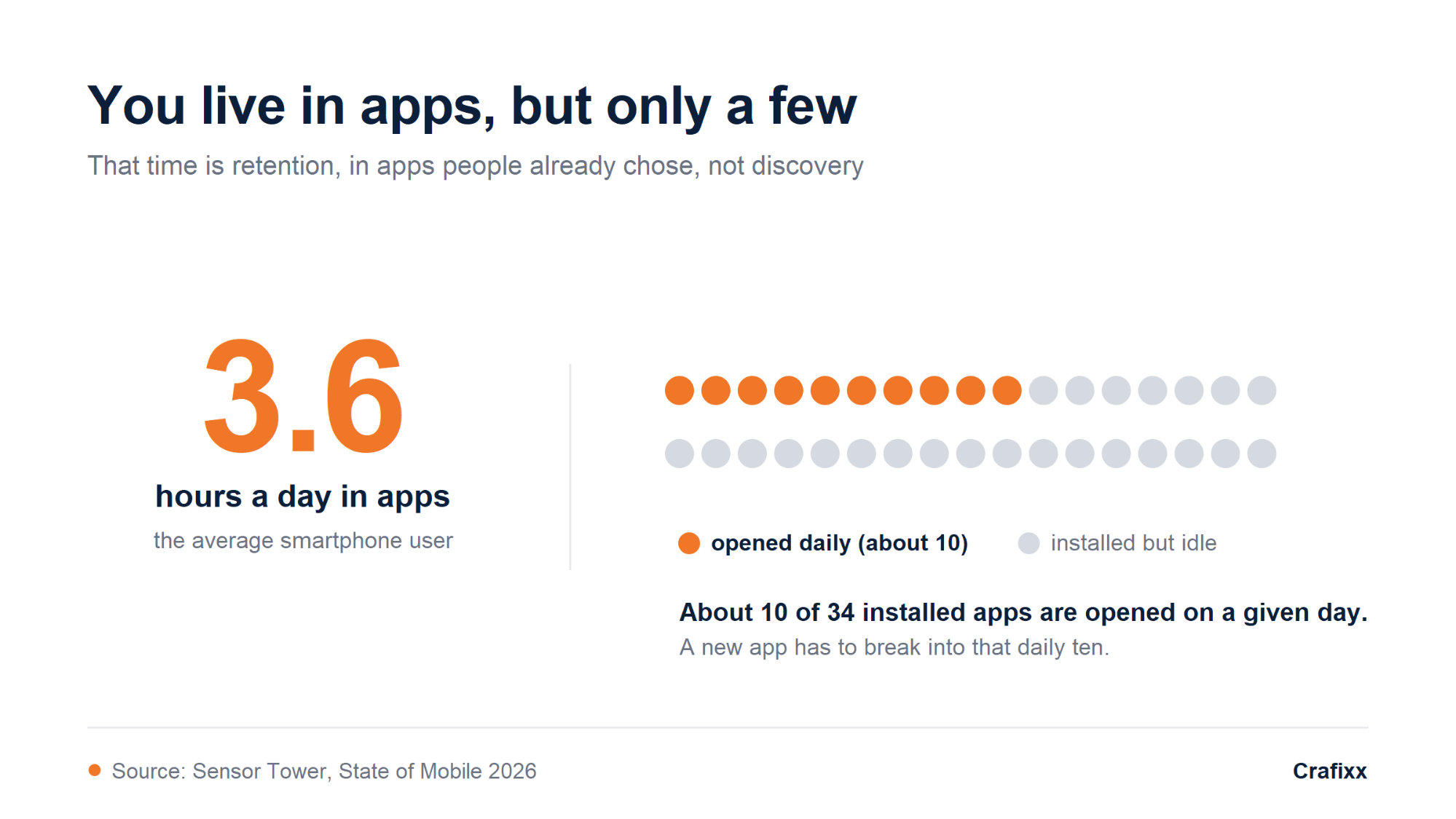
People clearly live in apps. The average person spends about 3.6 hours a day in them, yet opens only around 10 apps daily out of 34 installed (Sensor Tower, State of Mobile 2026). That is the catch, and it is easy to misread. All of that is retention time, spent in apps people already chose. It says nothing about discovery, which is how a new customer finds you in the first place. A new app has to break into someone's daily ten, and most never do.
An app makes sense when your customer uses you repeatedly and values:
If people will open you once a month, an app will sit unused. If they will open you three times a week, an app can become the product.
| Dimension | Website | Mobile app |
| Main job | Discovery, trust, reach | Retention, loyalty, frequent use |
| Found on Google and AI search | Yes | No (app stores only) |
| Friction to first use | One click, no install | Find, download, sign up |
| Time and cost to launch | Lower, faster | Higher, longer |
| Best for | Almost every new business | Frequent-use or loyalty-driven models |
Direct answer: An app is not just built, it has to pass Apple and Google review first, and an app that only wraps your website is usually rejected. A website has no gatekeeper.
Apple's App Store Review Guideline 4.2 requires real minimum functionality, and it specifically rejects websites simply repackaged as apps (Apple App Store Review Guidelines). That matters, because "just make an app version of the site" is exactly what many first-time founders ask for.
The bar is not small. In 2025 Apple rejected more than 2 million problematic app submissions (Apple). A website goes live the moment you publish it. An app has to earn its place on the store first, and only then on the home screen.
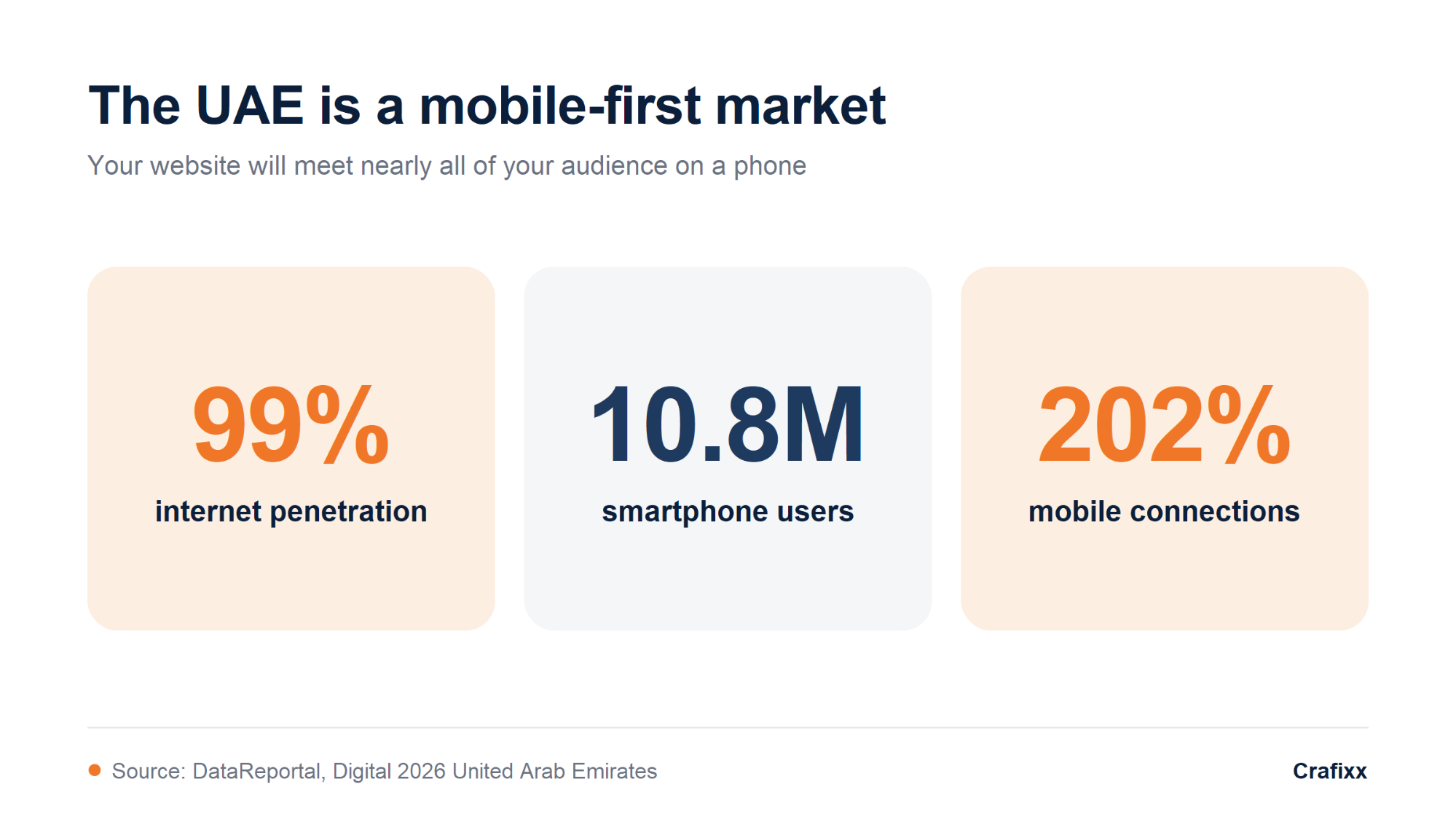
Direct answer: Almost all of them are on mobile, so your first job is a fast, mobile-first website, not an app.
The local context matters, and the UAE is an extreme case. It is one of the most connected markets on earth.
The takeaway is not "build an app because everyone is on mobile." It is that your website must be mobile-first and fast, because that is where nearly all of your audience will meet it first. A slow or clunky mobile site loses customers before an app is even a question.
Direct answer: Whether you launch a website or an app, if you collect personal data you must comply with UAE law, and apps often carry extra local requirements a website does not.
None of this rules out an app. It is one more reason the leaner first step, a compliant website, is usually the right place to start.
Run your business through these. The answers point clearly one way.
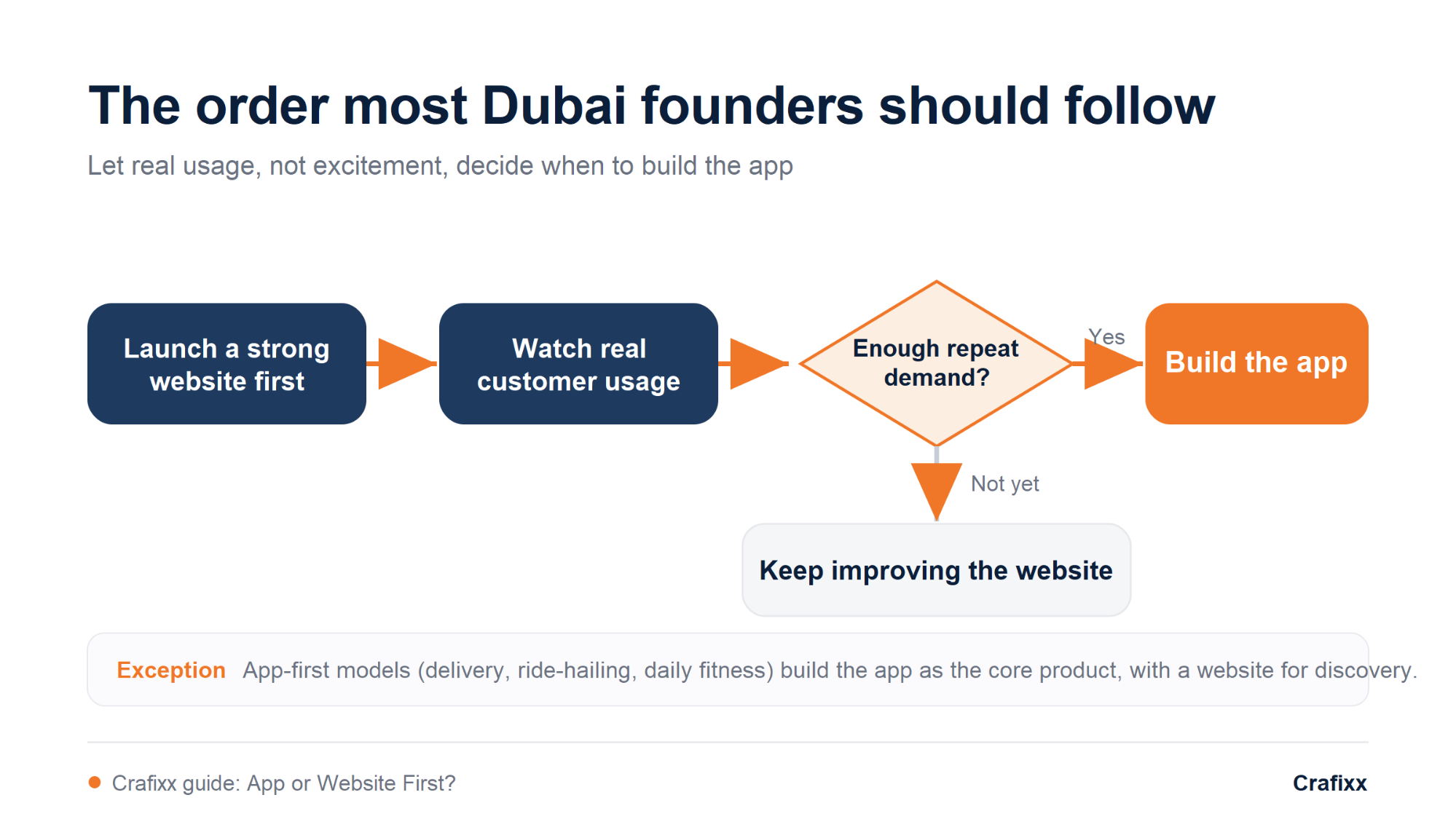
For the majority of businesses, the smart order is simple:
The exceptions. Some models are app-first by nature: on-demand delivery, ride-hailing, daily fitness or loyalty-heavy retail, where the app is the product. If that is you, the app is not a later step, it is the core build, and the website still supports discovery around it.
There is a third option many founders miss. A Progressive Web App, or PWA, is a website that behaves like an app. It can be added to the home screen, work partly offline and send some notifications, without a full native build or an app store listing.
For a business that wants an app-like feel but is not ready for a full native app on iOS and Android, a PWA can be a sensible, lower-cost step. It is not the right fit for everything, but it is often the smartest bridge between a website and a native app.
Direct answer: Cost depends far more on scope than on the label, and an app almost always costs more than a website because it takes more hours to build and maintain. The real drivers are:
Two neutral market benchmarks help set expectations, because most of the price is developer time, not the label on the project:
An app is usually built for both iOS and Android, needs more testing, and carries heavier ongoing maintenance, so it takes far more hours than a website that reaches everyone from a single build. For the same business, that is why a website almost always costs less and launches sooner, and why it is the safer first spend. When you are ready, our mobile app development team can quote against your real requirements
Ask Us Anything!
A website first, in almost every case. It handles discovery, trust and reach, which a startup needs immediately. An app is a strong second step once customers use you often enough to justify it.
Not by default. A website reaches everyone with no download and is found on search and AI answers. An app is better only when customers return frequently and value loyalty features like notifications and offline access.
Eventually many businesses do, but rarely at the same time. Start with the website, prove demand, then add the app. Even app-first businesses keep a website for discovery.
Yes. A well-built, mobile-first website is a strong foundation, and a Progressive Web App or a native build can extend it later without starting from scratch.
A PWA is a website that behaves like an app. It can be added to the home screen, work partly offline and send some notifications, at a lower cost than a full native app.
It depends on scope, not the label. Features, integrations, native versus cross-platform, and maintenance drive the price. A website is generally the lower-cost, faster first step.
We use cookies to help you navigate efficiently and perform certain functions. You will find detailed information about all cookies under each consent category below.
The cookies that are categorised as "Necessary" are stored on your browser as they are essential for enabling the basic functionalities of the site.
We also use third-party cookies that help us analyse how you use this website, store your preferences, and provide the content and advertisements that are relevant to you. These cookies will only be stored in your browser with your prior consent.
You can choose to enable or disable some or all of these cookies but disabling some of them may affect your browsing experience.