AI Brand Mentions vs Citations:
Why Being Named Is Not Being Cited


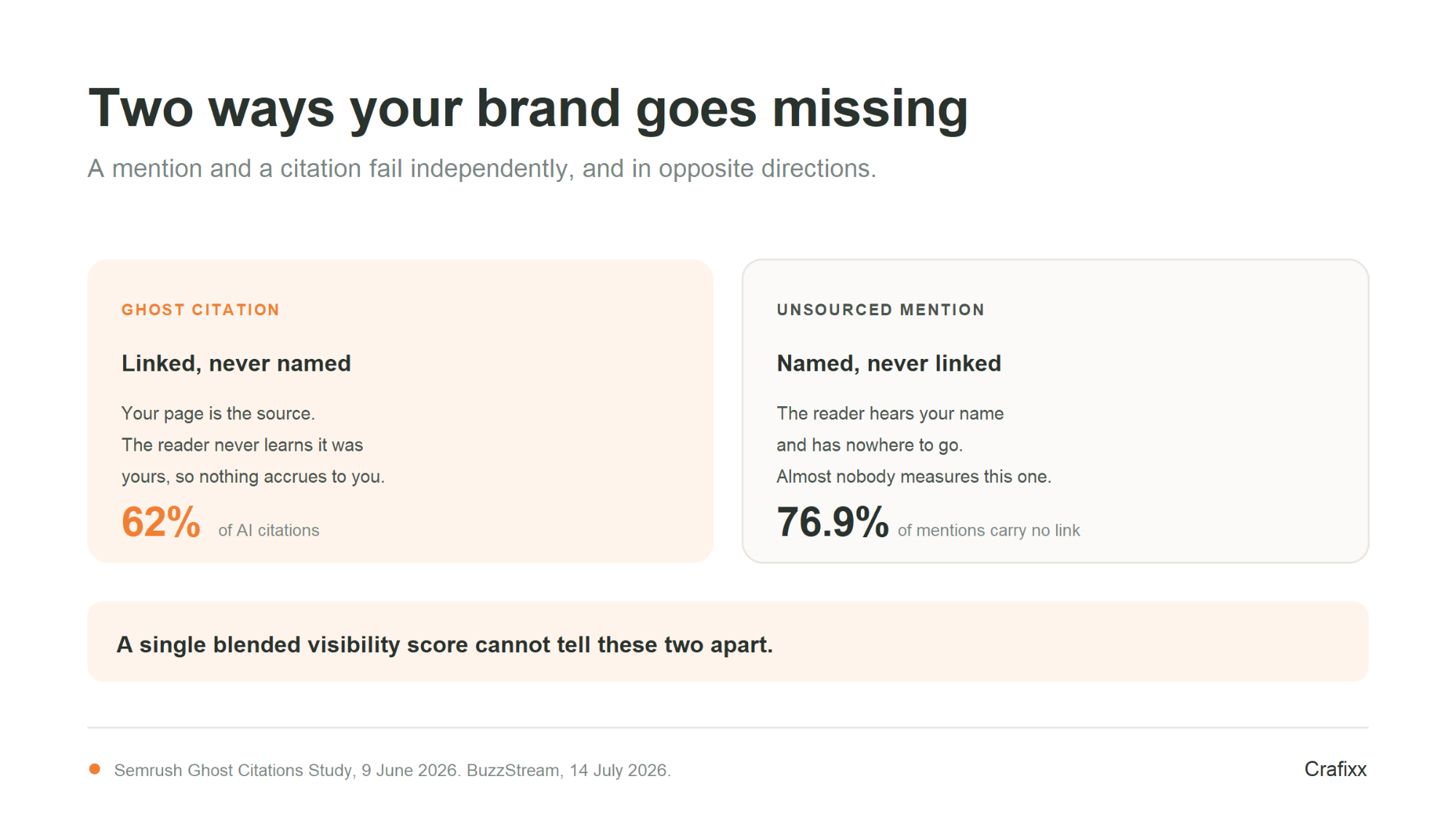
AI brand mentions and AI citations are two different outcomes. An AI brand mention is when an assistant says your name in an answer. An AI citation is when it links your page as the source. They are separate outcomes with separate causes, and most brands get one without the other. Semrush found 62% of AI citations never name the brand. BuzzStream found only 23.1% of brand mentions come with a link.
Almost every AI visibility report collapses these two into a single score. That is the mistake. You can be quoted by an assistant a hundred times and remain invisible to the reader, or be named constantly with nothing to click. This page explains both failure modes, what the published data says about how common each one is, and what to do differently about each.
An AI brand mention is any occasion where an assistant writes your brand name into the text of its answer. It is a visibility outcome, not a traffic outcome. The reader sees your name, forms an impression, and may search for you later, but nothing on the page sends them to your site.
Mentions are driven by what the model associates with your category. If your name appears often enough, in enough independent places, alongside the right topics, assistants will produce it when the topic comes up. That is why mentions correlate with entity strength rather than with page optimisation.
An AI citation is when the assistant links your page as a source for what it just said. It is a traffic and trust outcome. Citations are driven by page-level factors: whether your page answers the specific question directly, how retrievable it is, and how clearly the claim sits on the page.
| AI brand mention | AI citation | |
| What happens | Your name appears in the answer text | Your page is linked as a source |
| What the reader gets | Awareness of your brand | Somewhere to click |
| Primarily earned | Off your site, across the web | On your site, page by page |
| Driven by | Entity strength and topical association | Answer clarity and retrievability |
| Fails when | The model does not associate you with the topic | Your page does not answer the question directly |
| Measured as | Mention rate, share of voice | Citation share, citation rate |
The difference matters because the two are earned in different ways. A mention is earned across the web. A citation is earned on your page. Work that improves one does not automatically improve the other, which is the whole reason this distinction is worth a page of its own. Set out side by side, the AI citations vs mentions comparison comes down to six things.
There are two distinct failure modes, and they are opposites. Most teams only ever look for one of them, which is why the other keeps happening unnoticed.
The ghost citation. The assistant uses your page, links it, and never says your name. Kevin Indig coined the term, and Semrush defines it exactly that way in its Ghost Citations Study published 9 June 2026: your site gets a source link, but the AI never says your name in the answer. Your content did the work. The reader has no idea it was yours.
The unsourced mention. The assistant names you and links nothing. The reader hears about you and has nowhere to go. This is the direction almost nobody measures, and it is more common than the ghost citation.
Often enough that a single-number visibility score is close to useless. Three independent studies published within eight weeks of each other all found large gaps, in both directions.
| Finding | Figure | Source |
| AI citations that never name the brand | 62% | Semrush Ghost Citations Study, 9 June 2026 |
| AI citations that leave the brand unnamed | about 40% | Writesonic data, reported by Search Engine Land, 29 July 2026 |
| Brand mentions that include a citation | 23.1% | BuzzStream, 14 July 2026 |
| Citations that do include the brand name | 69.9% | BuzzStream, 14 July 2026 |
Read the BuzzStream pair together, because they are the clearest statement of the problem. Roughly seven in ten citations do name the brand, but fewer than one in four mentions come with a link. Getting named is the easier half. Getting named and linked in the same answer is rare.
Perplexity and Google AI Mode are the worst offenders, and Microsoft Copilot is the best behaved. The Search Engine Land analysis by Nikki Lam and Samanyou Garg, published 29 July 2026, examined roughly 16 million brand appearances over a 30 day window and broke the ghost citation rate down by engine.
| Platform | Citations that never name the brand |
| Perplexity | 52% |
| Google AI Mode | 49% |
| Google AI Overviews | 41% |
| ChatGPT | 37% |
| Gemini | 25% |
| Grok | 22% |
| Microsoft Copilot | 19% |
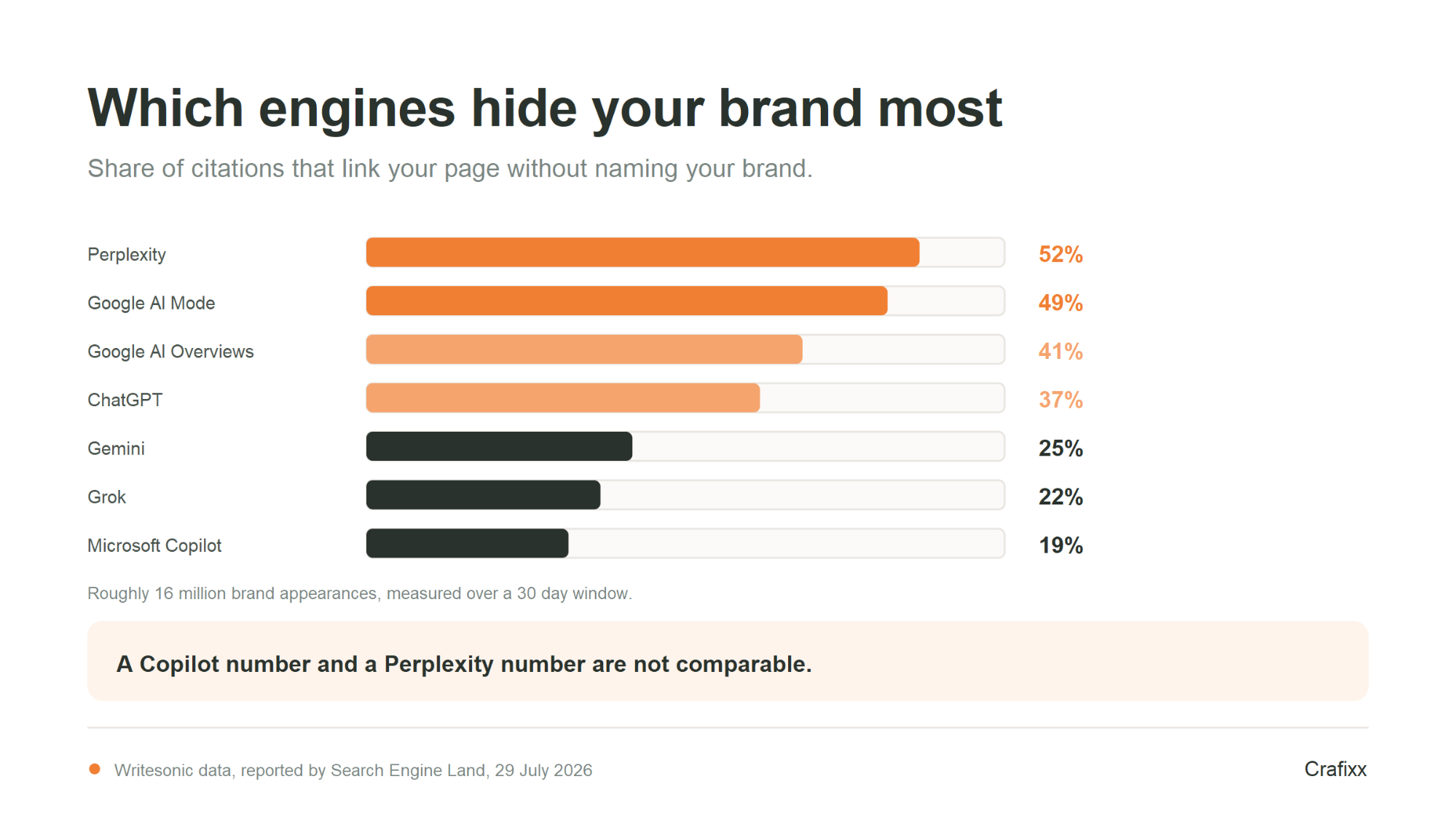
The spread is the point. A brand tracked only on Copilot and a brand tracked only on Perplexity are not measuring the same thing, and neither number transfers to the other engine.
Semrush's study found the two largest assistants running almost mirror-image patterns. When a brand appears in a Gemini answer it is named in the text 83.7% of the time but cited as a source only 21.4% of the time. ChatGPT does the reverse, with an 87% citation rate against a 20.7% mention rate.
Gemini talks about you. ChatGPT quotes you. If your reporting blends the two engines into one score, those two opposite behaviours cancel each other out and you learn nothing.
There is a structural reason underneath this. The Semrush 2026 AI Visibility Index, published 26 June 2026 from 126 million US prompts, found ChatGPT cites an average of 15 sources per response while Gemini cites an average of 3. More citation slots means more chances to be linked, and less pressure to name anyone in the prose.
Semrush says 62%, Writesonic says 40%, and both are right about their own dataset. Different prompt sets, different engines, different time windows and different definitions of a brand appearance produce different numbers. That is not a flaw in the research, it is the nature of measuring a probabilistic system.
The practical rule is the one set out in our guide to measuring AI visibility: never compare a number from one tool against a number from another. Compare your own measurement against your own earlier measurement, taken the same way, on the same prompts, on the same engines.
It also explains why so many teams feel lost here. The Semrush index found that 45% of marketing leaders cannot accurately measure their brand visibility within AI generated answers. That is not incompetence. It is the absence of a shared standard until very recently.
Both, but not with the same work, and not in the same place. Mentions are won off your site. Citations are won on it. Neither, it is worth saying, requires rebuilding your website, which is a question we take apart in SEO vs GEO.
If the goal is to increase visibility with AI brand mentions rather than clicks, the work happens away from your website.
Six steps. The first four are free and need no tool at all.
You do not need a paid tool to start. You do need one to sustain it at any scale.
What you already have, free. Your server logs and analytics will show AI crawler activity and referral traffic from assistant platforms, which tells you about citations. They will tell you nothing about AI brand mentions, because a mention generates no request. That blind spot is exactly why mentions need deliberate tracking.
The manual prompt panel. A spreadsheet, a frozen prompt list and a scheduled hour. It is slow, it does not scale, and it is more honest than most dashboards because you can see every answer you counted.
What to demand from any paid tracker. The Interactive Advertising Bureau published Measuring Visibility in the AI Era on 3 August 2026 precisely because more than 20 vendors sell this measurement using incompatible methods. It sets a bar worth borrowing. Before you buy, insist the tool discloses query volume, sample size, prompt type coverage, testing cadence, reproducibility and platform coverage. On top of those six, add one more for this topic specifically: it must report mentions and citations as separate figures. A tool that gives you one blended visibility score cannot tell you which of the two problems you have.
We use cookies to help you navigate efficiently and perform certain functions. You will find detailed information about all cookies under each consent category below.
The cookies that are categorised as "Necessary" are stored on your browser as they are essential for enabling the basic functionalities of the site.
We also use third-party cookies that help us analyse how you use this website, store your preferences, and provide the content and advertisements that are relevant to you. These cookies will only be stored in your browser with your prior consent.
You can choose to enable or disable some or all of these cookies but disabling some of them may affect your browsing experience.